
Her på Blåvand's blog bringes korte nyheder i dagbogsformat om livet og hændelser på fuglestationen.
-
FORSIDE

- Blog
Se indlæg fra måned: mar. (31)apr. (30)maj (31)juni (16)juli (18)aug. (32)sept. (30)okt. (31)nov. (16)
Lifers for everyone
tirsdag 27. oktober 2026
Ringing:
Ringing was cancelled due to weather conditions.
Observations:
As ringing was cancelled due to weather again today I joined Anton for another day of slow obs. We had low visibility and winds were still quite stormy so there were no passerine migration, but we did get an ocean to observe. We had 1824 Common Scoters (Melanitta nigra) which is the highest number I've been present for, and then some nice species to suprise us. I found my lifer Little Auk (Alle alle) which gave quite a stir. As we've had som good Alcid migration these last days, we doubled checked for as long as possible, until the individual passed a Little Gull and we felt quite stupid for doubting it even a second. The undisputed highlight of the day came in the form of a Leach's Storm Petrel (Hydrobates leucorhous) found by Anton. My first seen outside the bunker, and it gave quite a different experience. It was Anton first storm petrel so extremely nice, and good to be a self found individual for him as well.
Tomorrow we say goodbye to Anton after 40 days of migration counts. He will be sorely missed around the house and on the beaches of Denmarks westernmost point.
At the station: Anton, Storm, Mathilde, Johan, Helena
Finally, a Dovekie!
mandag 26. oktober 2026
Ringing: Closed due to heavy winds and rain.
Observation: I have a grudge with the military. The military area has been open the last week pretty much, but on this exact day, they were closed - probably the worst timing possible...The weather was absolutely horrific with powerful winds (15-16 m/s) directly from the west and pretty heavy rain. In these conditions it is paramount to be in the Sabine's bunker. Not only can you get seabirds extremely close from there, but you can obs in cover of both rain and wind. The problem is, that the Sabine's bunker is positioned about 1,8 kilometres into the military area, so we were forced to obs in straight headwinds and lots of rain. I will say, however, that it was mostly worth it!
While the rain and wind made it quite difficult to obs, and we didn't meet standard today, we still did manage some good species and decent numbers. Almost 2000 Common Scoters (Sortand), 103 Caspian Gulls (Kaspisk måge) - most likely a migratory record -, and 103 Alcids (Alkefugle) migrated by obs today. The highlight species of today were a Black-throated Loon (Sorttrubet Lom), a Dovekie (Søkonge), and a Sooty Shearwater (Sodfarvet Skråpe). Black-throated Loons have been quite uncommon this season, and this is only the 6th seen at obs during the fall season. And as for the Dovekie, this is the first find of the species at obs this season, and really a species we have been looking for the last couple of weeks. So overall, despite the weather, a pretty damn good obs, if I do say so myself…
At the Station: Mathilde Sif Eiby, Anton Ræbild Jensen, Johan Them Steffensen, Storm Hauris Borum, Helena
1 Sooty Shearwater and a Bunch of Little Gulls...
søndag 25. oktober 2026
Ringing: Cancelled due to heavy rains and winds.
Observation: Listen, I don’t want to be known as that guy at Blåvand Fuglestation who writes all the pessimistic blogs complaining about “the good seawatch-days”, but… man, I’m tired of people hyping up western winds that are supposed to bring Storm Petrels and Sabine’s Gulls (Sabinemåge). All they ever bring are 1 Sooty Shearwater (Sodfarvet Skråpe) and maybe a good helping of Little Gulls (Dværgmåge). I always say this at the station whenever somebody gets hyped for a “good” wind (I have been burned 1 too many times), and I have yet to be proven wrong - including today!
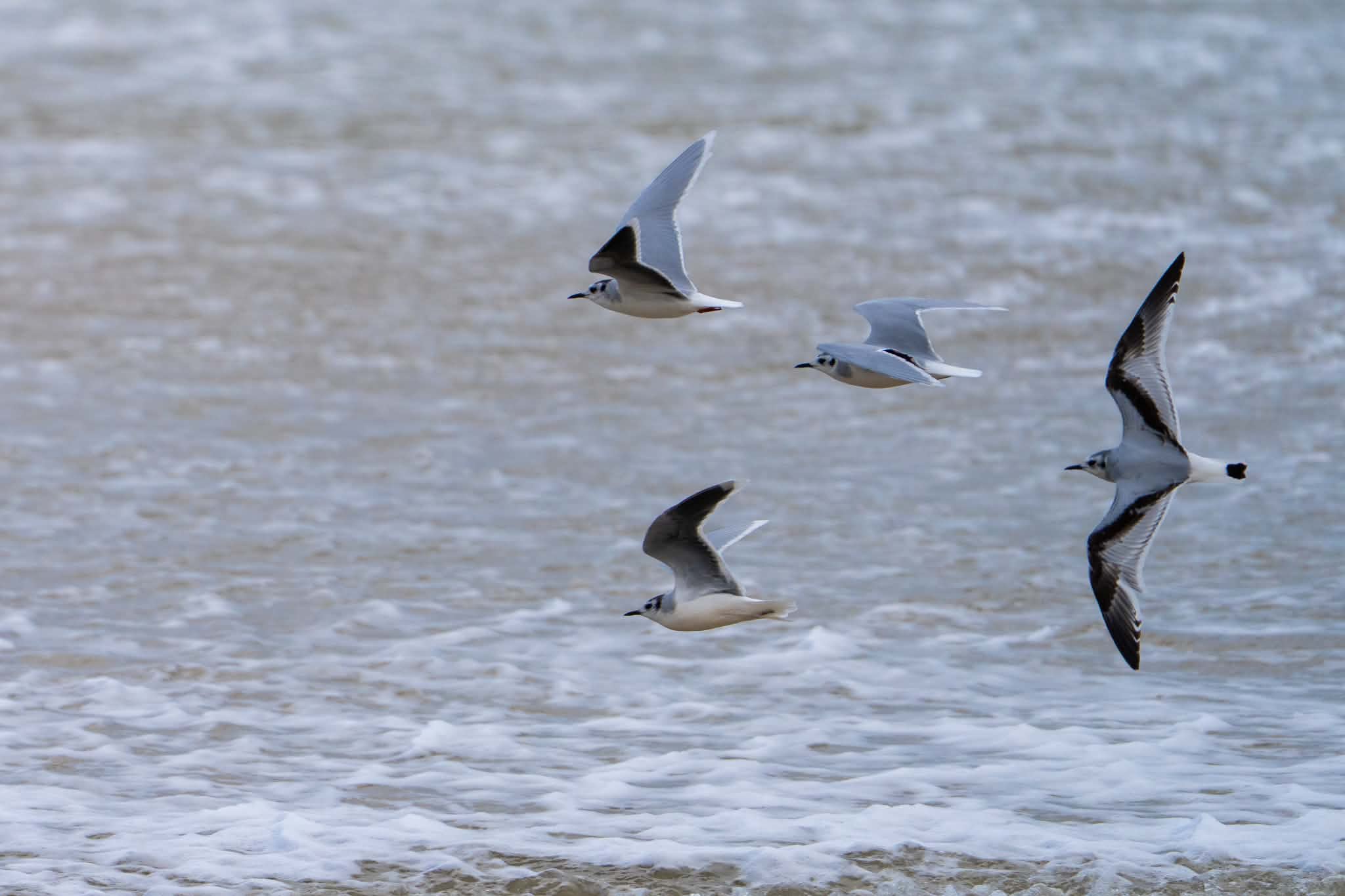
A mixed flock of adult and first year Little Gulls. Credit Henrik Lindgaard.
As predicted, we got our 1 Sooty Shearwater, and we did get our little gulls. However, I was surprised that we managed a total of 569 Little Gulls. By far the most I have ever seen in one day. The Scoters were also moving, with both species setting season records. A total of 4010 Common Scoters (Sortand) and a whopping 89 Velvet Scoters (Fløjlsand) flew by us at obs.
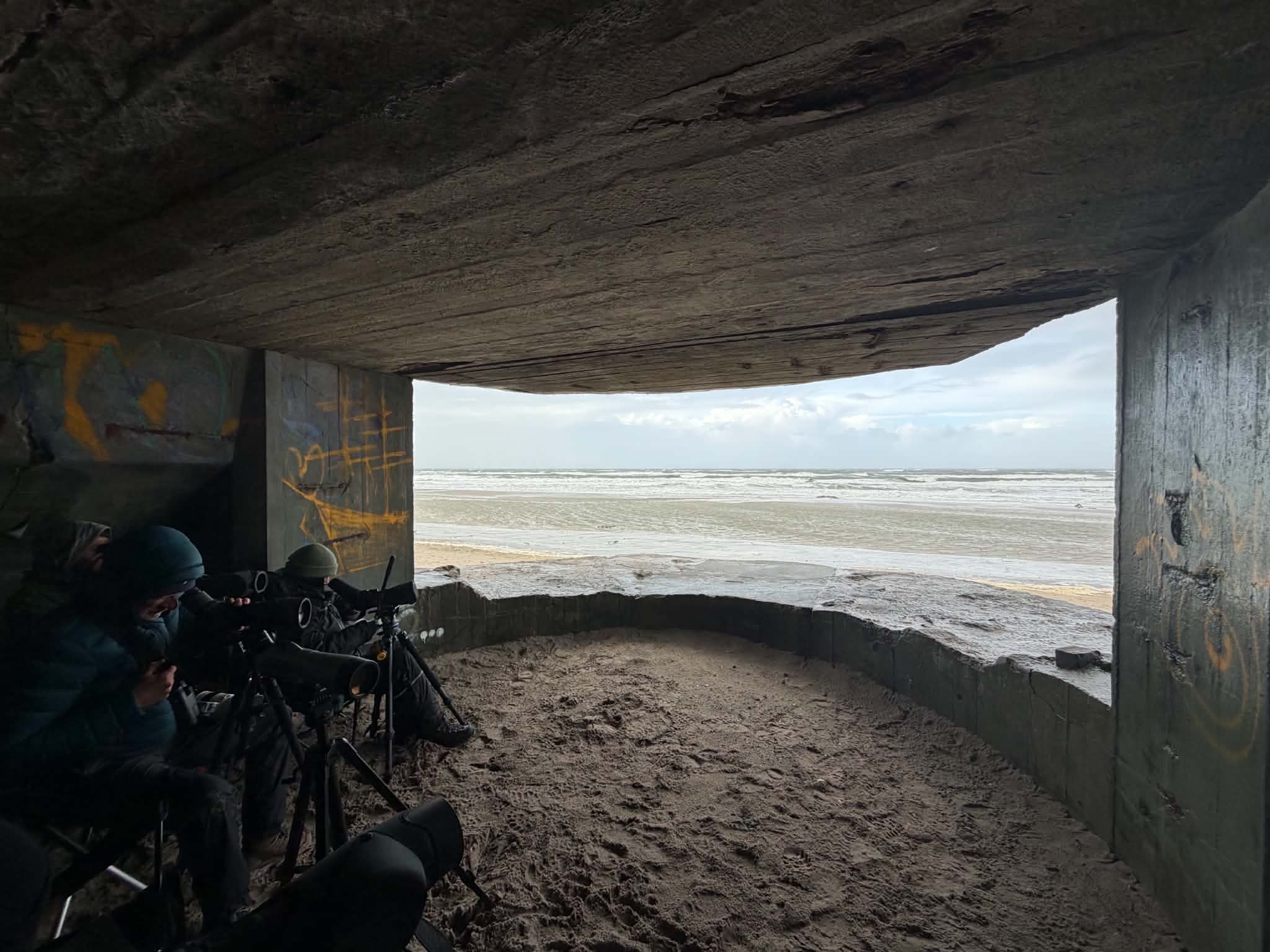
The view at obs today. Credit Nanna Bakke.
The other highlights of today's obs were a single Arctic Tern (Havterne) and 1 Long-tailed Duck (Havlit) - both species that haven’t been daily at obs lately.
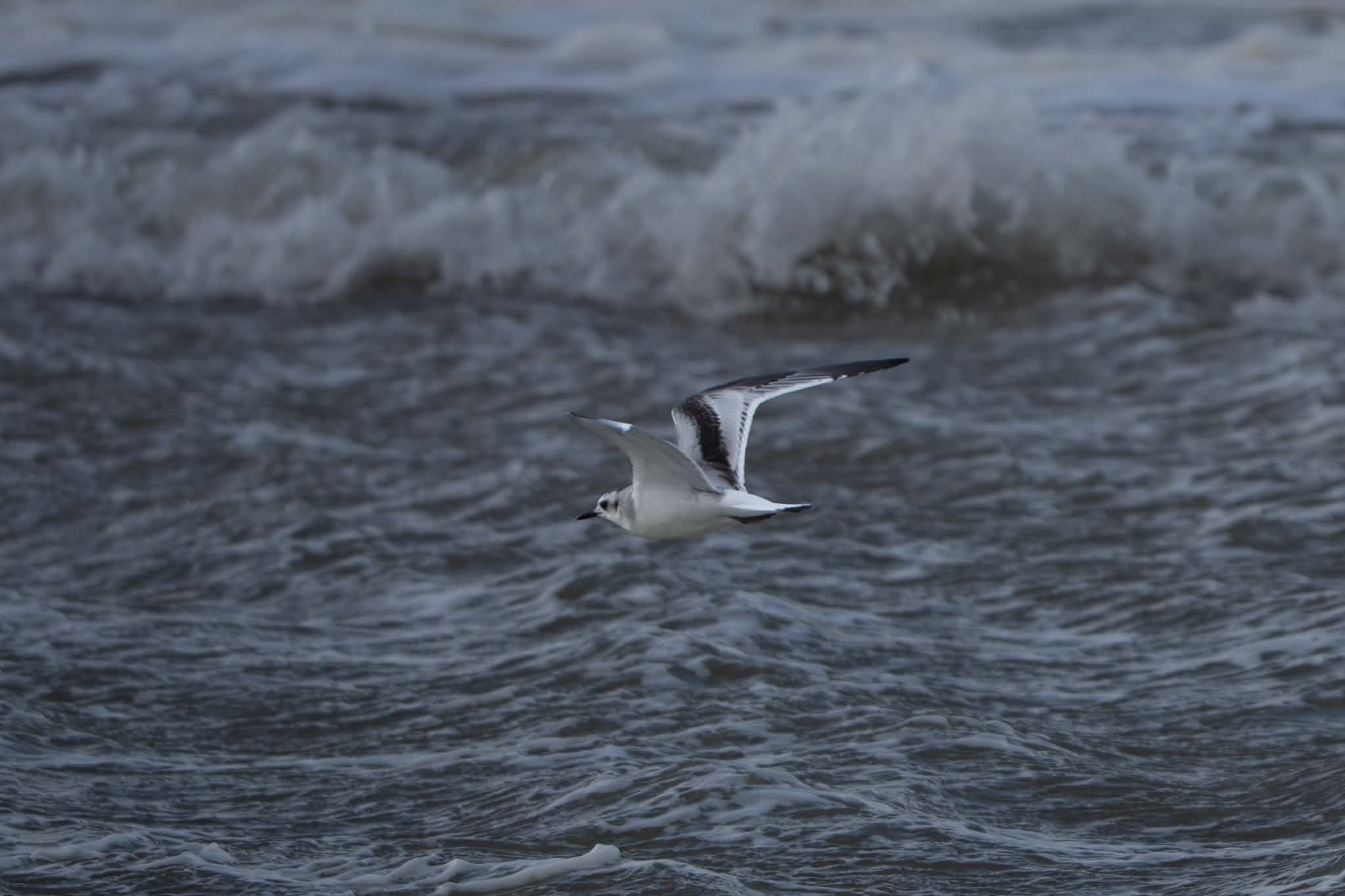
One of the close fyling Little Gulls. Not usually a species that gets close to the beach. Credit Henrik Lindgaard.
Unfortunately, the rain came in and the migration pretty much ended immediately. We held out at obs for another hour or so, but as the birds didn’t seem to want to continue their journey, and with the promise of warm coffee at home, we decided to head back.
At the Station: Mathilde Sif Eiby, Anton Ræbild Jensen, Johan Them Steffensen, Storm Hauris Borum, Helena
The mosekone is brygging
lørdag 24. oktober 2026
Ringing: Today was one of those ringing days that take forever. Due to the rain we delayed opening an hour, and after that did more frequent rounds, so the birds wouldn't get drenched in the nets - but in reality, what birds? Late in the morning the drizzle finally dissapeared, but we only ended up with 8 birds in total, even though we persisted through a full standardized ringing.
The next few days look like no ringing at all, so not the best condtitions for my last week in Blåvand, but at least obs looks promising the next two days!
Today's numbers:
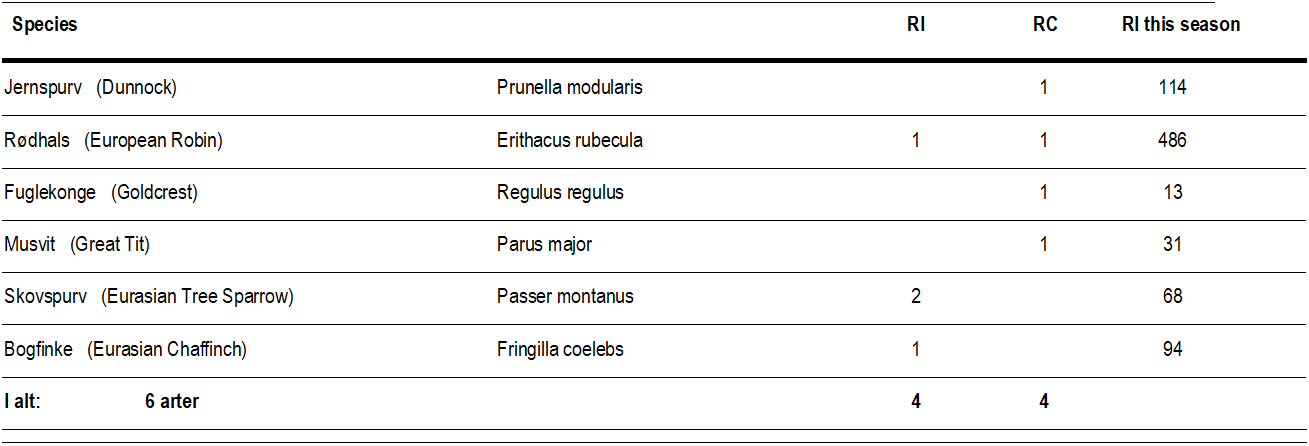
Observation:
Anton was feeling under the weather today, so I (Johan) covered obs. This was a tactical decision as there were no birds at all. We were troubled with fog making no birds visible, and water to make us all wet. The highlight of the was 2 resting and 1 migrating Long-tailed Duck (Clangula hyemalis). These ducks look quite exotic and are quite rare lower down in Europe, so we made an effort to appreciate them the most we could.
At the Station: Mathilde Sif Eiby, Anton Ræbild Jensen, Johan Them Steffensen, Storm Hauris Borum, Helena
NUTCRACKERS FOR EVERYONE
fredag 23. oktober 2026
Ringing: Today started out as another chill day with lower volume - 19 birds of 10 species. And what a beautiful morning here at the station!
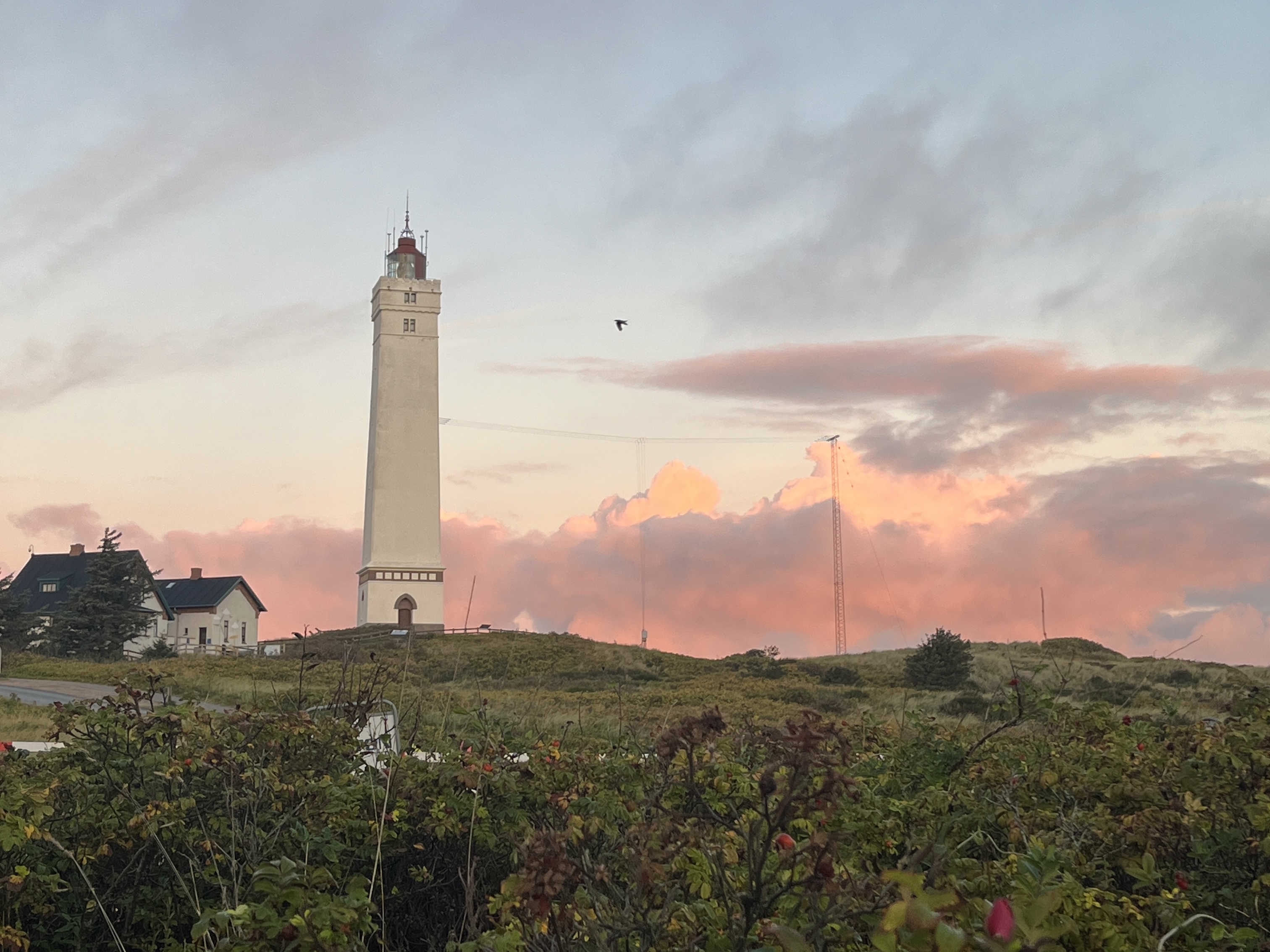 Our view when doing rounds at the station. Picture by Mathilde Sif Eiby.
Our first cool encounter of the day were two Bullfinches (Dompap), a male and a female. Bullfinches normally don't like being held for too long, so after doing data we just took a single picture and let them go on their way.
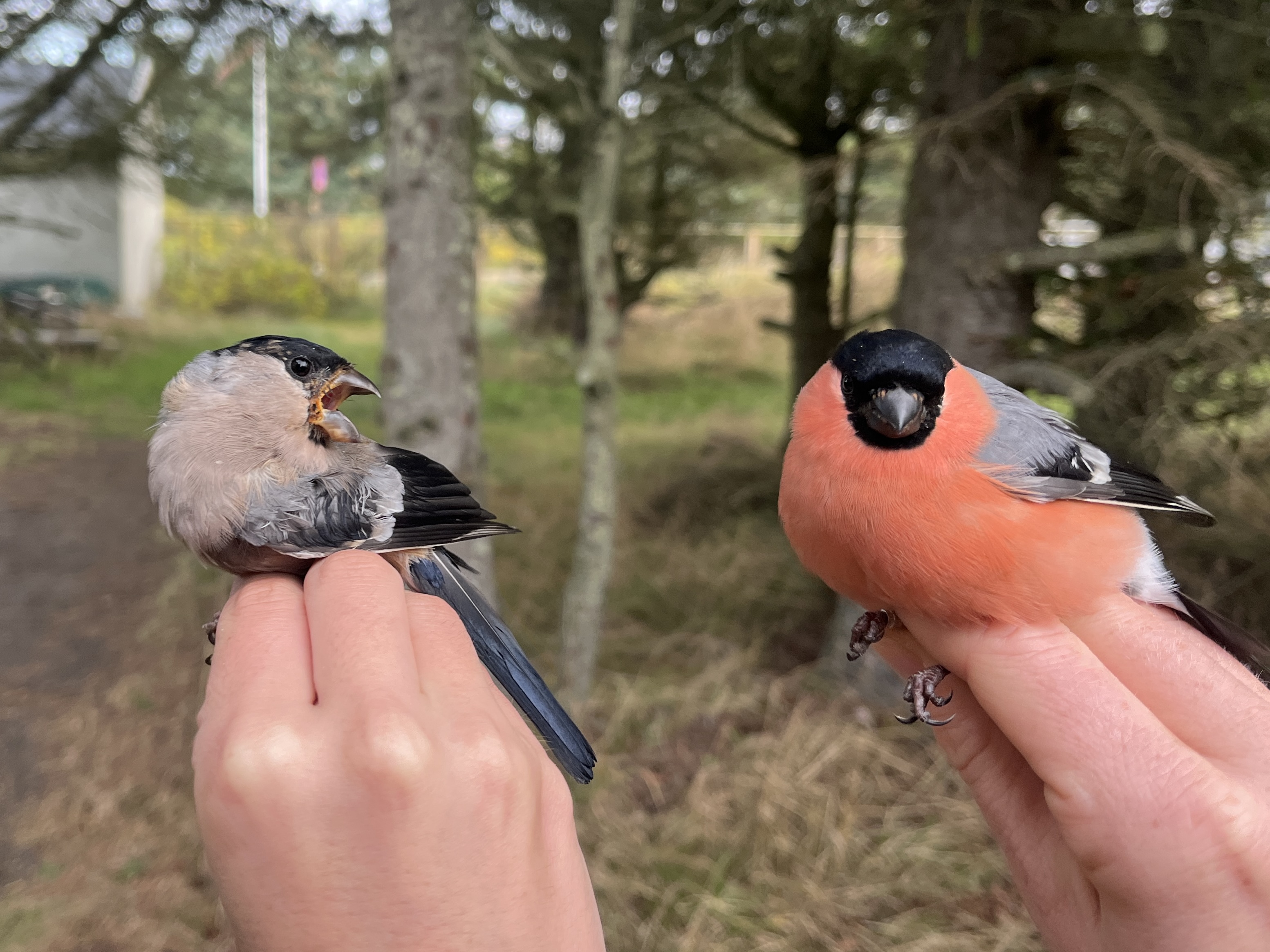 Bullfinches - to the left a young female born this year, and to the right a probable adult male from a previous year. Picture by Mathilde Sif Eiby.
The rest of the standardized ringing went by, but just when we were about to go on our closing round, Storm sent a promising message in the group chat: "NØDDEKRIGE". (Nutcracker). Shortly after Johan came down to the station with a big smile and handed me a bag. And if you thought our fourth Nutcracker in 8 days (and fourth one ever ringed at the station) wasn't enough; while I was ringing it in the lab, Henrik came in with ANOTHER ONE. They'd seen the second one fly over, and after a few seconds of Antons famous mixtape, it had too gone straight into the net!
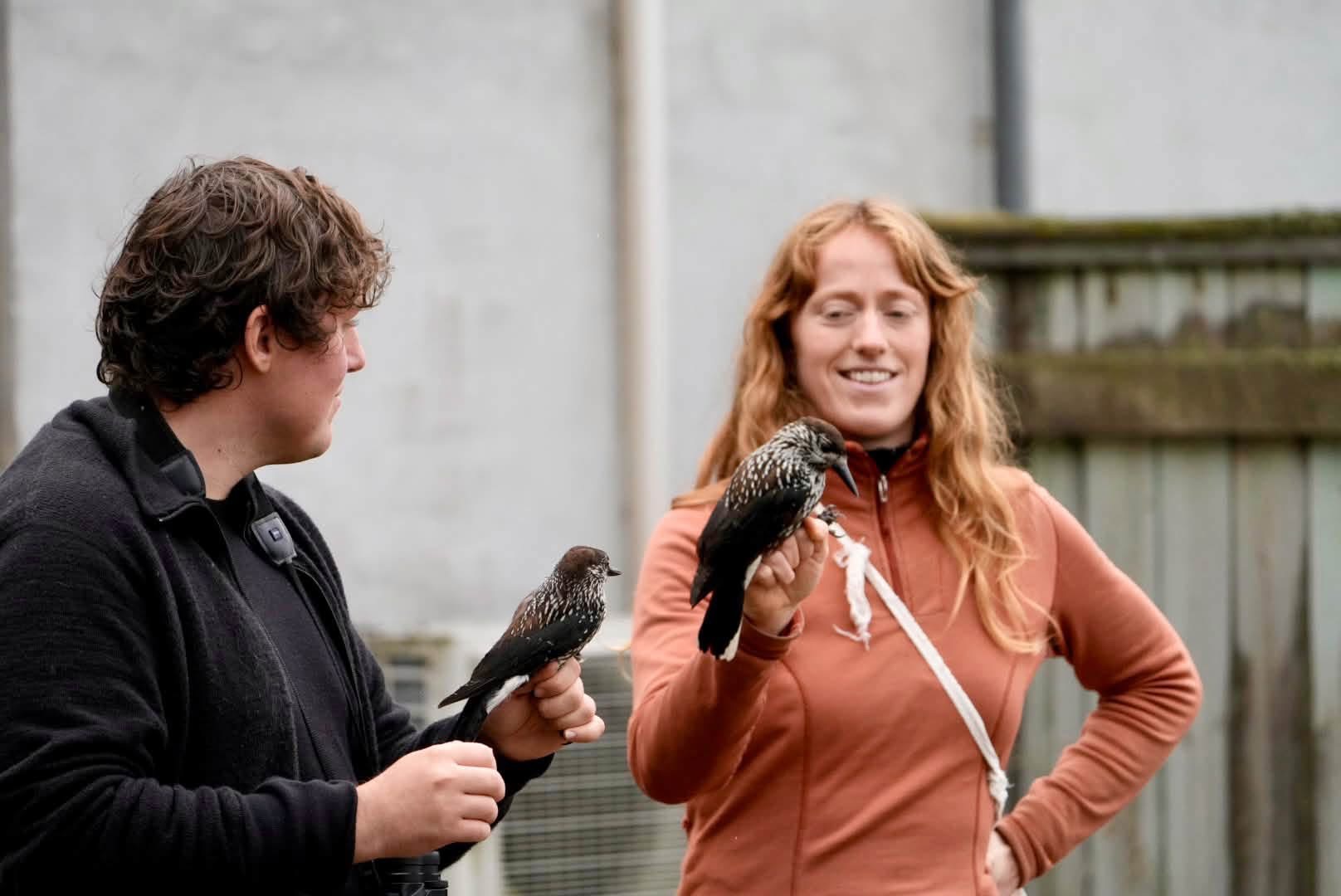 Anton and I displaying today's Nutcrackers. Picture by Henrik Böhmer.
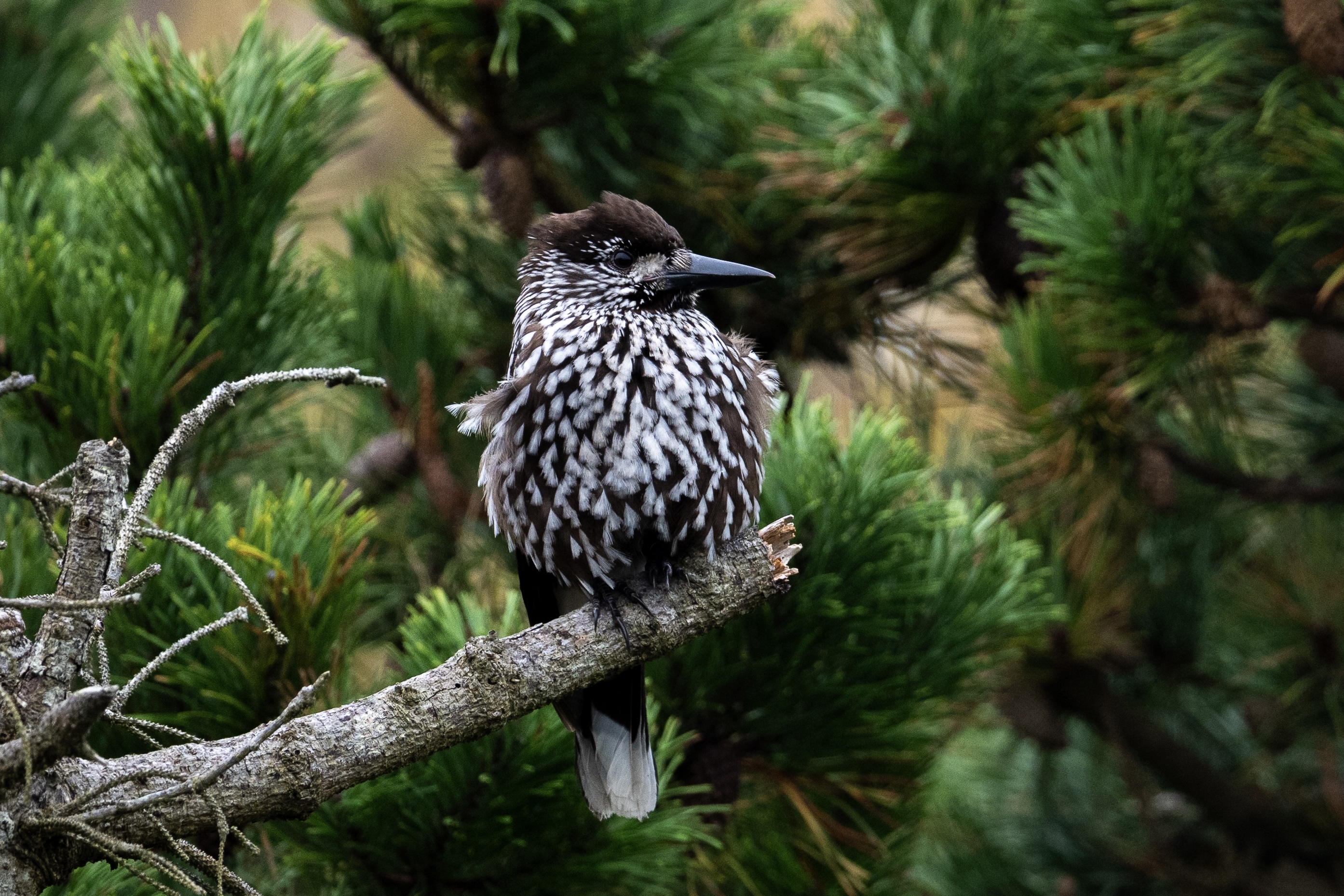 One of the Nutcrackers stayed around for a little while after we released them. Picture by Anton Ræbild Jensen.
With five Nutcrackers now having visited our nets, we're starting to get a better understanding of the ageing. The two birds today were both young birds born this year, with moult limits in the feather group called medium coverts, between the few retained old baby feathers that are browner, shorter and with wide white tips, and the rest new black feathers with triangular white tips. They also both had retained juvenile greater coverts and primary coverts - both feather groups with white tips on all feathers, of which adult birds should have no or only few white tips, according to our favourite french book. If you look at the pictures from the 16th, you can see the adult bird we had for comparison!
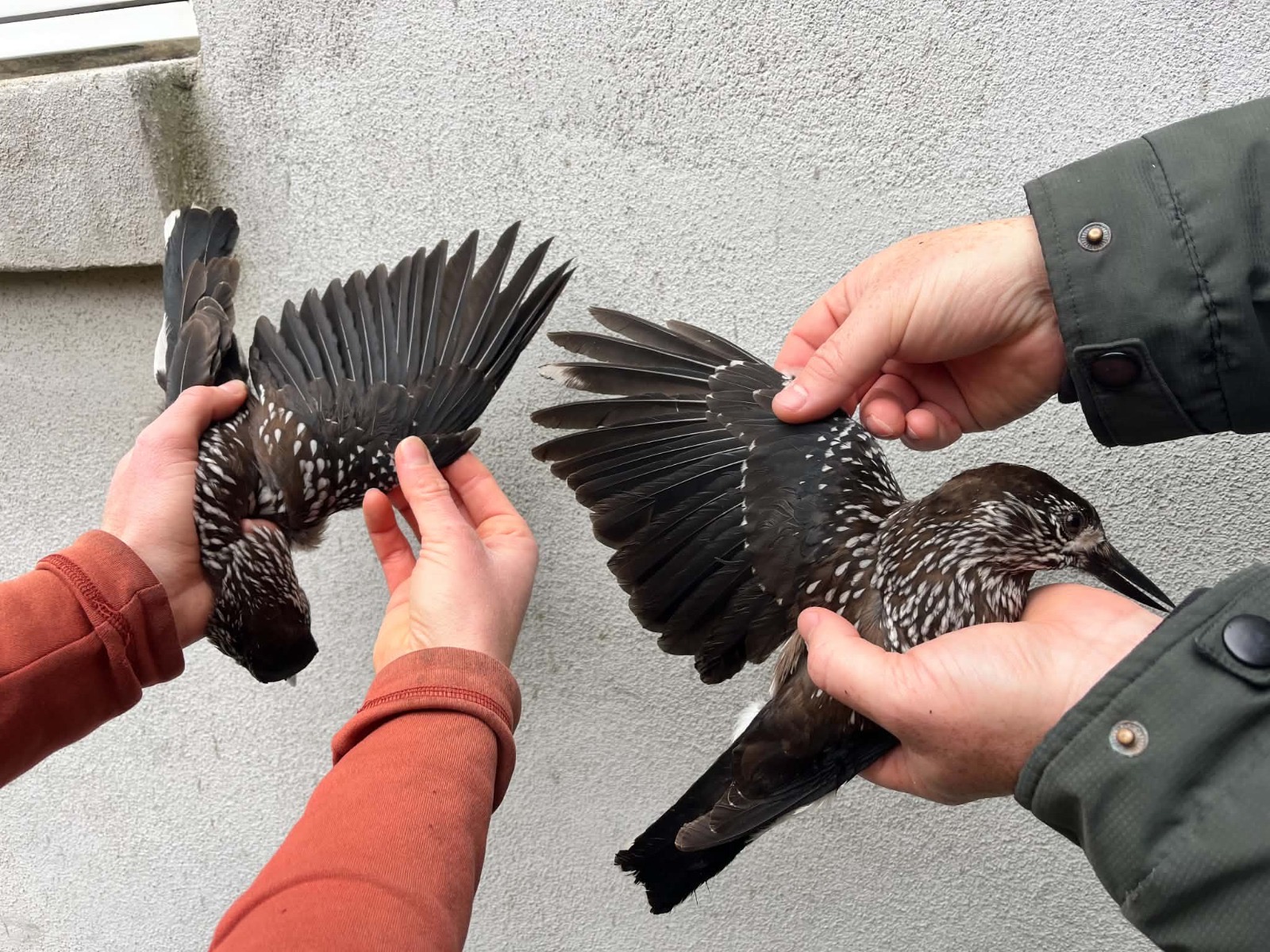 Two young nutcrackers from today. Picture by Henrik Lindgaard.
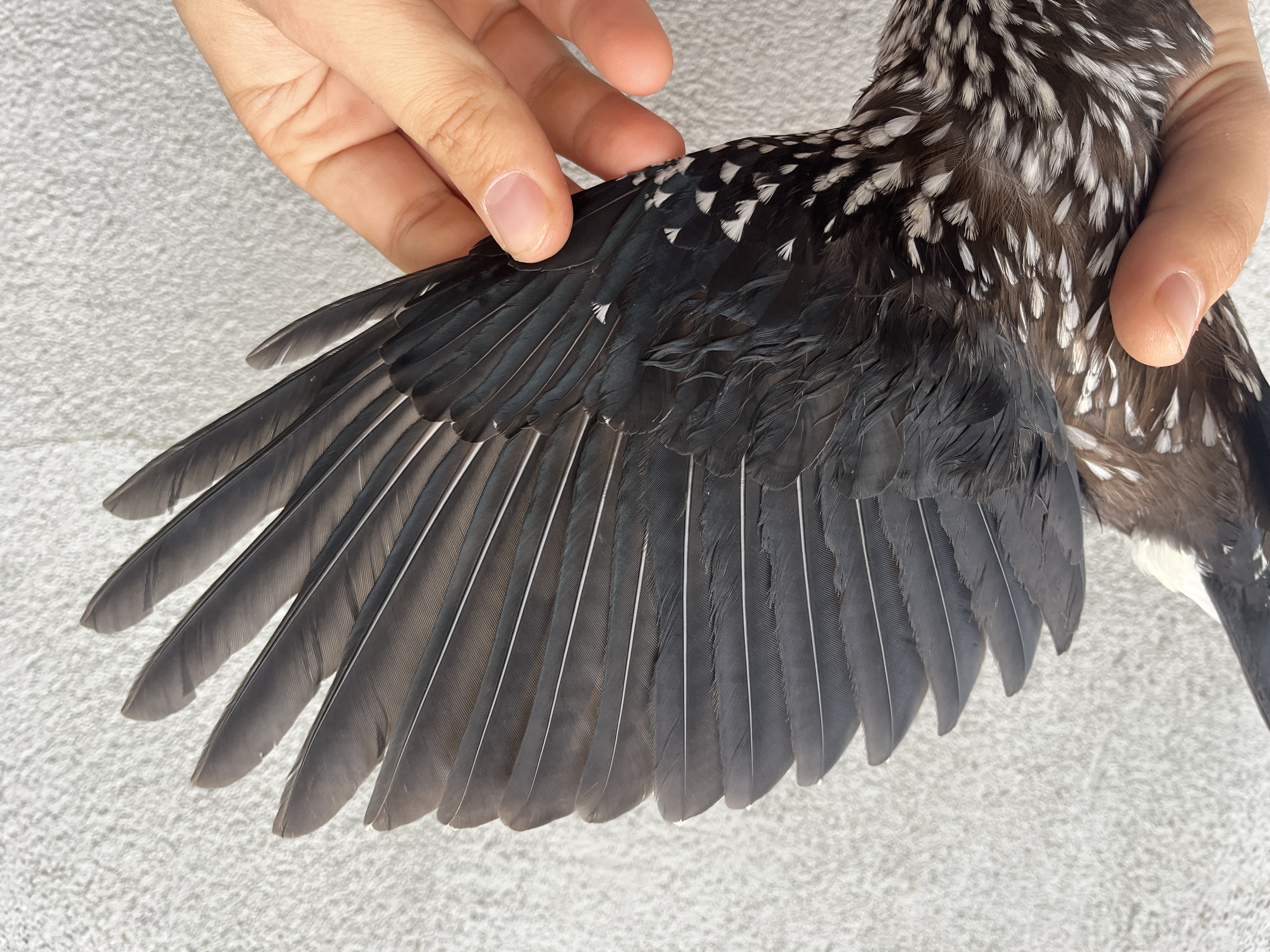 The adult Nutcracker from the 16th of october. Aged by the lack of white tips on greater and primary coverts, as well as pure adult feathers in the medium coverts with solely triangular white tips. Picture by Mathilde Sif Eiby.
Today's numbers:
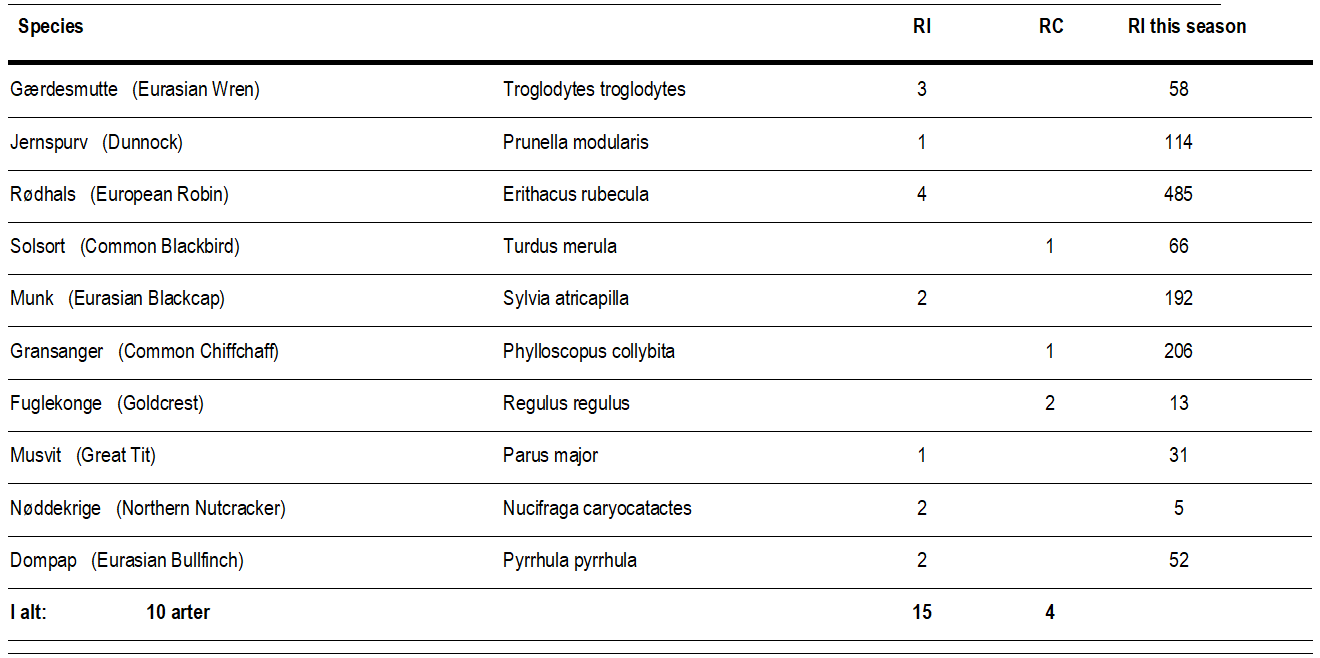
Observation: Oh wow, another banger of an obs!
While the numbers were nothing to write home about (with only 253 Common Scoters (Sortand), 28 Red-throated Loons (Rødstrubet Lom), 30 Greylag Geese (Grågås), and 54 Little Gulls (Dværgmåge)), the quality certainly was.
The first good bird of the day was already at 08.10 in the morning. I was alone at the Huk when I heard a weird Tree Pipit-like (Skovpiber) call and saw a small pipit fly by me. I noted the time, but didn’t think more about the bird as I got distracted. Luckily, I was recording, and when I opened the recording in Audacity, I was intrigued… the call certainly looked like that of an Olive-backed Pipit (Tajgapiber). After discussing it with Henrik, he agreed, and I gotta say, I was ecstatic!
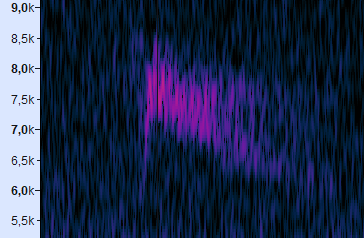
Here is the spectrogram of the pipit call. The length of the modulations, as well as the number of modulations, support Olive-backed Pipit. Furthermore, both the mean frequency and the highest frequency are high for Tree Pipit.
Now, I have had Olive-backed Pipits on the Huk before (3 this season already), but I have never actually managed to find one on my own before, so this is kind of a big milestone for me. This is also the first bird I have found on my own that would have to be approved by the Danish Rarity Committee. Hopefully they agree with me…
But this is not where the hit-filled obs ends, as just 25 minutes after the pipit, I managed to spot a loon that looked absolutely gigantic. As it got close, I could easily see it was a Common Loon (Islom) that, despite its name, is the first surefire find of this species at obs this season. Usually, they would already have arrived at least a couple of weeks ago, but as with most species this year, they have arrived quite late.
The last “hit” we managed to squeeze out at obs today was a pretty sizeable flock of Red Crossbills (Lille Korsnæb) that flew right overhead. A total of about 22 birds were seen, which is the highest amount this season.
Unfortunately, my luck ran out there, as heavy rain/fog rolled in at sea, completely killing any migration and any remaining visibility today. Still, I have no complaints: two good birds and 22 Red Crossbills in nothing to scoff at.
At the Station: Mathilde Sif Eiby, Anton Ræbild Jensen, Johan Them Steffensen, Storm Hauris Borum, Helena
New Winds, New Birds!
torsdag 22. oktober 2026
Ringing: Closed due to heavy winds...
Observation: New winds are always great, and today was proof of that. Usually, winds from the east and southeast are very good in Blåvand, but yesterday and the day before yesterday were just kind of mediocre. So I (Anton) was certainly happy when I looked at DMI and saw that the wind would quickly switch to a decent (12 m/s) wind from the southwest.
The wind brought both good numbers and good species. As for the numbers, the most notable ones were the 1520 Common Scoters (Sortand), the 15 Velvet Scoters (Fløjlsand), the 55 Little Gulls (Dværgmåge), and the 170 Northern Gannets (Sule) flying by.
And as for the species, the most notable ones were 2 Kittiwakes (Ride), 1 Black Guillemot (Tejst), 1 Arctic Skua (Almindelig Kjove), 1 Red Phalarope (Thorshane), and 1 Puffin (Lunde). I had never seen a Puffin or a Red Phalarope at sea before (only ever resting), so it was nice to get an impression of how they look in flight far out. The bird of the day, according to Henrik, was however neither the Puffin nor the Phalarope - it was apparently the Black Guillemot. Black Guillemots are quite rare at Blåvands Huk (have I learned today), which I could definitely feel on the way Henrik called it out for us at obs. It had been quiet for five minutes when he suddenly yelled: “Black Guillemot, there's a Black Guillemot! Anton, do you see it?!”. I have never seen him so excited for a bird, perhaps with the exception of the Red-throated Pipit (Rødstrubet Piber) we had earlier in the season. I must admit, I couldn’t match Henriks excitement for the Black Guillemot… where I come from (Fyn), there are several breeding locations close by, and it is a relatively common bird locally. To me, I think the highlights of today must be either the Little Gulls or the decent number of first year Northern Gannets - both things I haven’t seen a lot this year.
The wind tomorrow goes back to the southeast… I am not really sure what to expect, but maybe something good comes by obs. If not, I might have go looking in the bushes for something rare and skulky. Either way, I am hopeful that we can match today's results tomorrow!
At the Station: Mathilde Sif Eiby, Anton Ræbild Jensen, Johan Them Steffensen, Storm Hauris Borum, Helena
Just a few locals
onsdag 21. oktober 2026
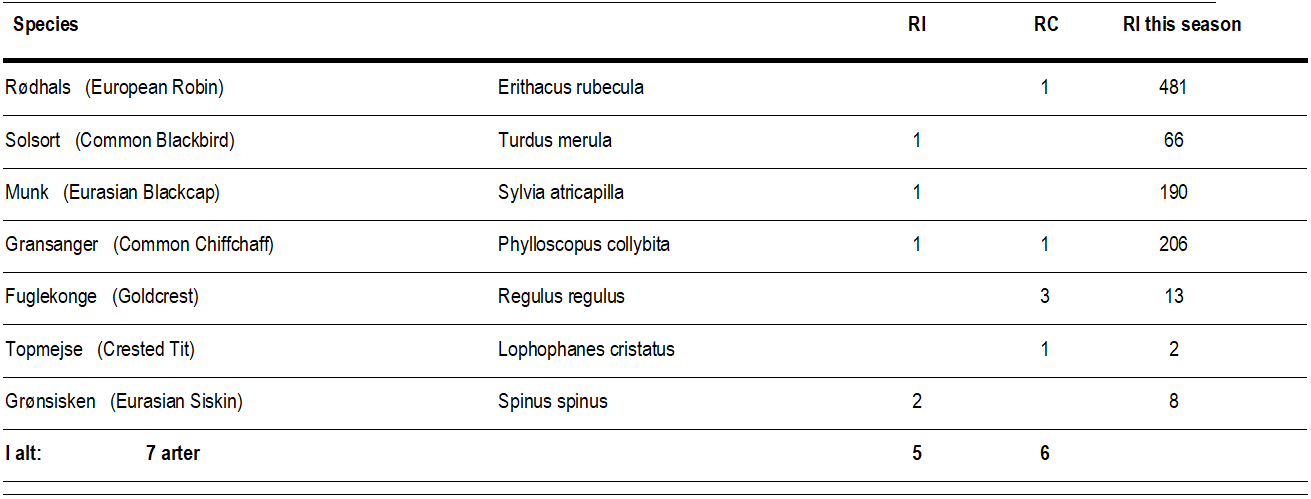
Ringing: Pretty high wind today resulted in not that many birds in the nets. We ended up with 11 birds in total, which exceptionally consisted of more recaptures than new birds.
The local Goldcrests (Fuglekonge) have been revisiting the nets a few times now, as well as our local Crested Tit (Topmejse). Both species we would actually really like to get more newly ringed of, especially the Goldcrests are caught in dramatically lower numbers than usual.
Today's numbers:
Observation: Today was quite similar (too similar, if you ask me) to yesterday. Luckily, unlike yesterday, I (Anton) was joined by David, which helped greatly with my enjoyment of the obs. The wind was still from the east, and very few birds were in the air. The most notable ones were the geese and ducks - of these, the most interesting ones were the 108 Wigeons (Pibeand), 14 Greater White-fronted Geese (Blisgås), the 12 Pintails (Spidsand), and the 4 Tufted Ducks (Troldand). A single Mallard also joined us at obs, which is a species I have not seen a lot of the last month or so out here.
Other than the ducks, most numbers were low. Even the usual suspects were few, with only 279 Common Scoters (Sortand), 19 Red-throated Loons (Rødstrubet lom), and no migrating Meadow Pipits (Engpiber) or Chaffinches/Bramblings (Bogfinke/Kvækerfinke).
Hopefully tomorrow will be more exciting…
At the Station: Mathilde Sif Eiby, Anton Ræbild Jensen, Johan Them Steffensen, Storm Hauris Borum, Helena
Goodbye Strummer
tirsdag 20. oktober 2026
Ringing: Today we had 41 birds of 13 species. The Chiffchaffs (Gransanger) were suddenly back to being our most numerous bird, and we even had one of the biggest I've ever seen - 67mm wing and 9,1g weight! It was an adult as well (not born this year), with the broadest tail and best feather structure I've ever seen on a Chiffchaff too.
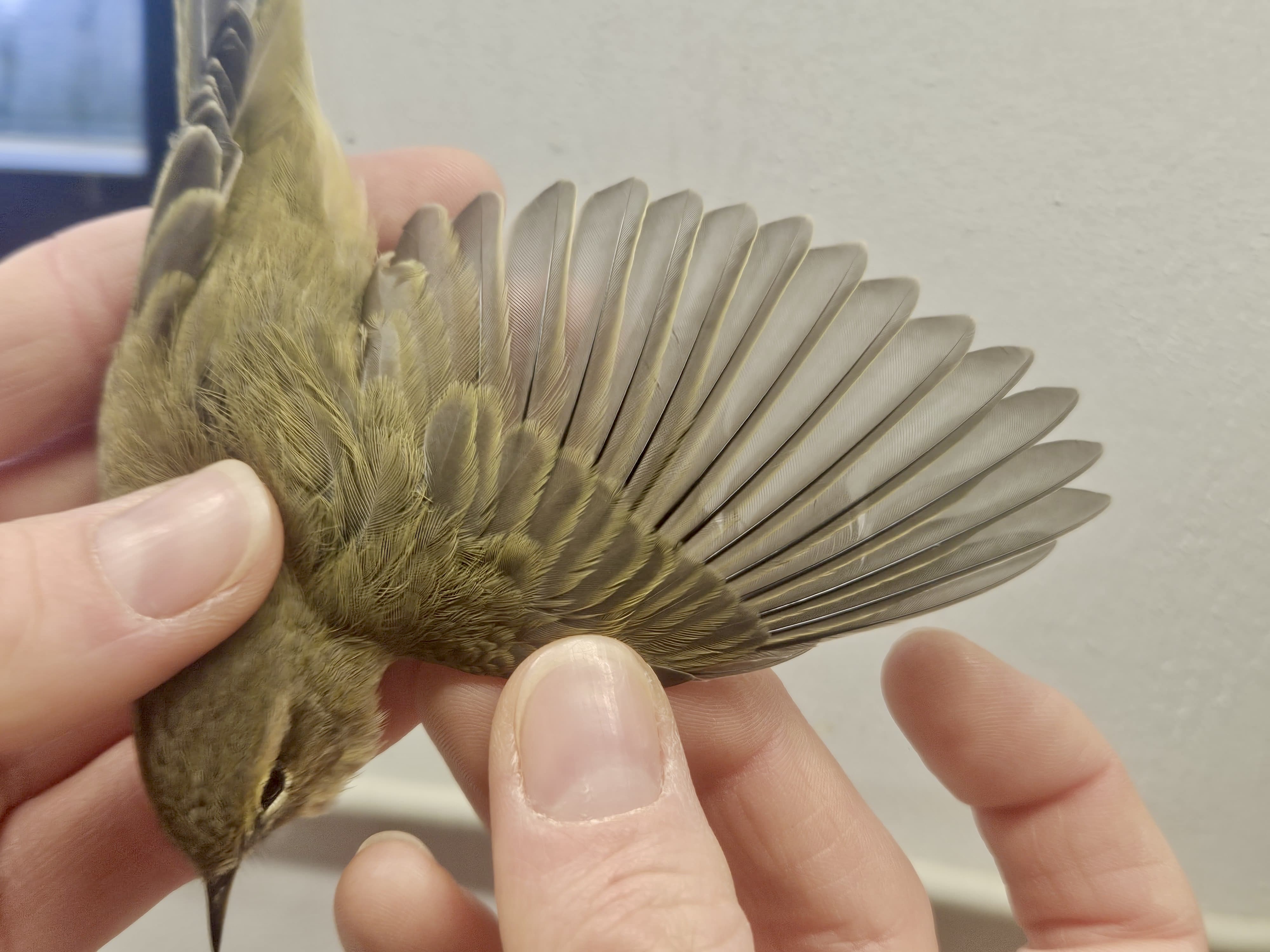
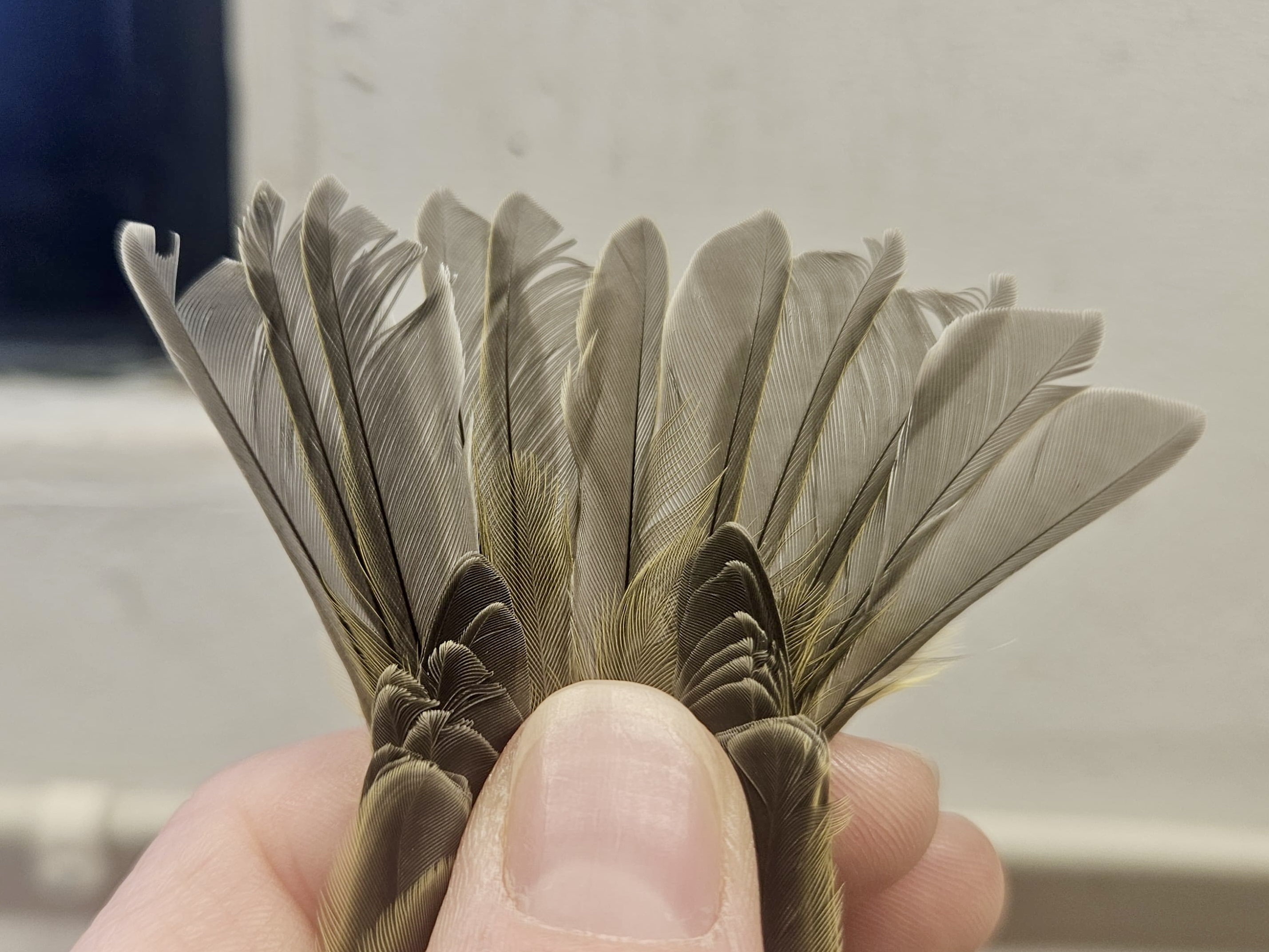 To the unexperienced eye, this might look like a regular old Chiffchaff, but this was a NICE bird. Pictures by Storm Hauris Borum.
We also had a good amount of thrushes again, five of which were Blackbirds (Solsort), and they were really showing off their wide variation today.
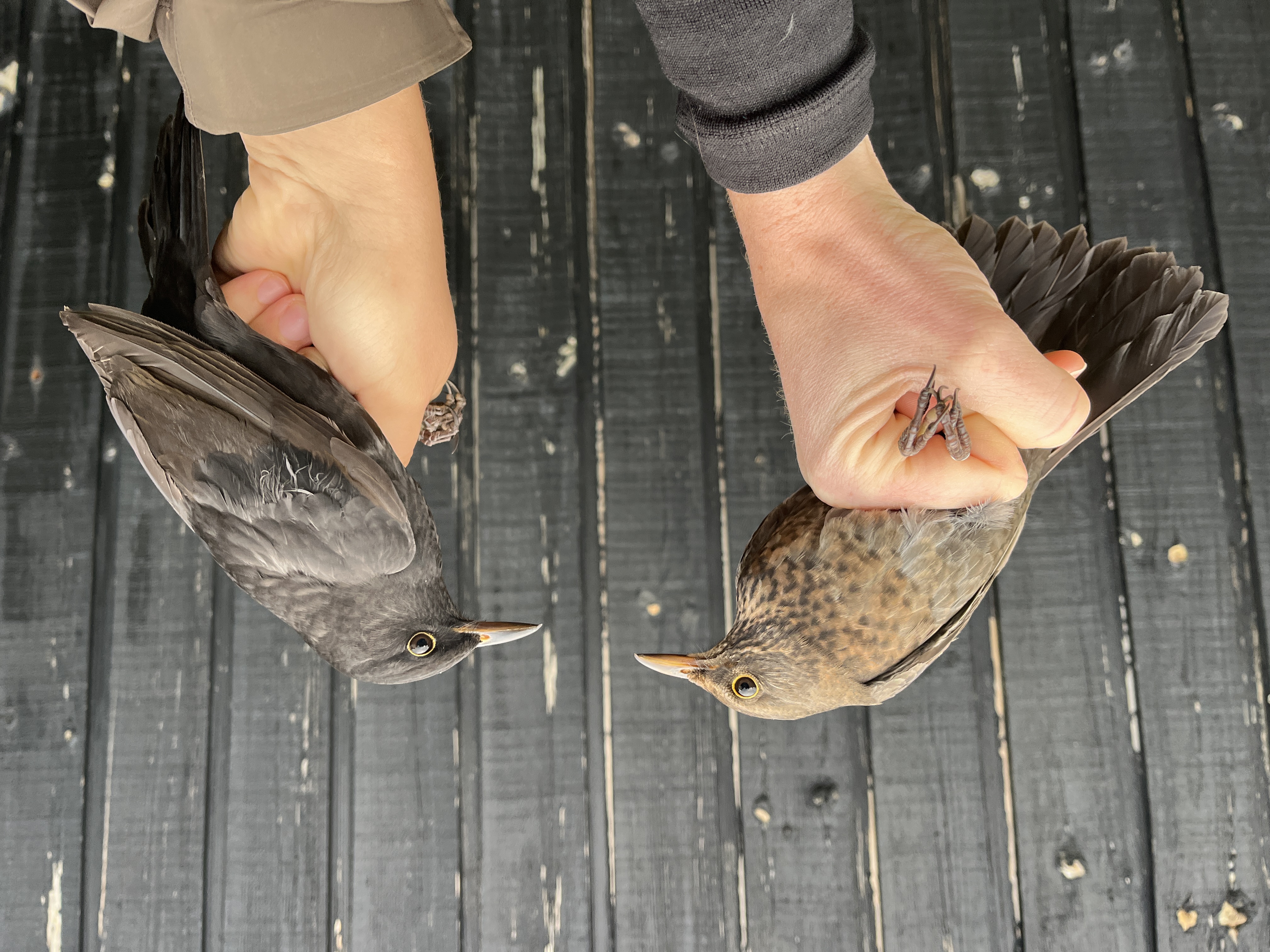
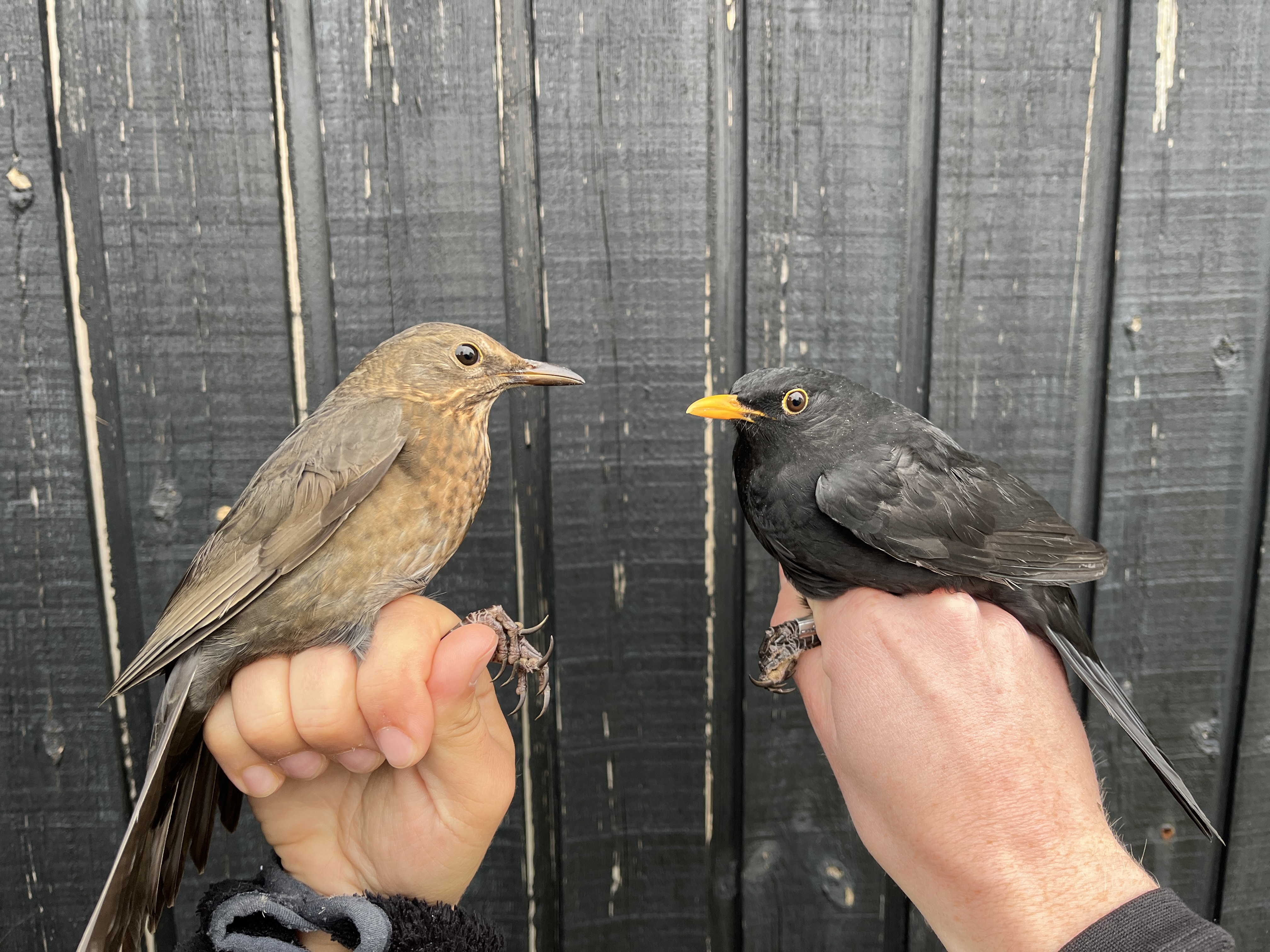 On the left both young females, the bottom one the palest Storm and I had ever seen. On the right both males, the top one born this year, aged on the brown feathers (old baby feathers) contrasting to the black ones (new teenage feathers) and the dark bill, while the bottom one is a clear adult bird (born a previous year), with a pure black plumage and yellow bill. Pictures by Mathilde Sif Eiby.
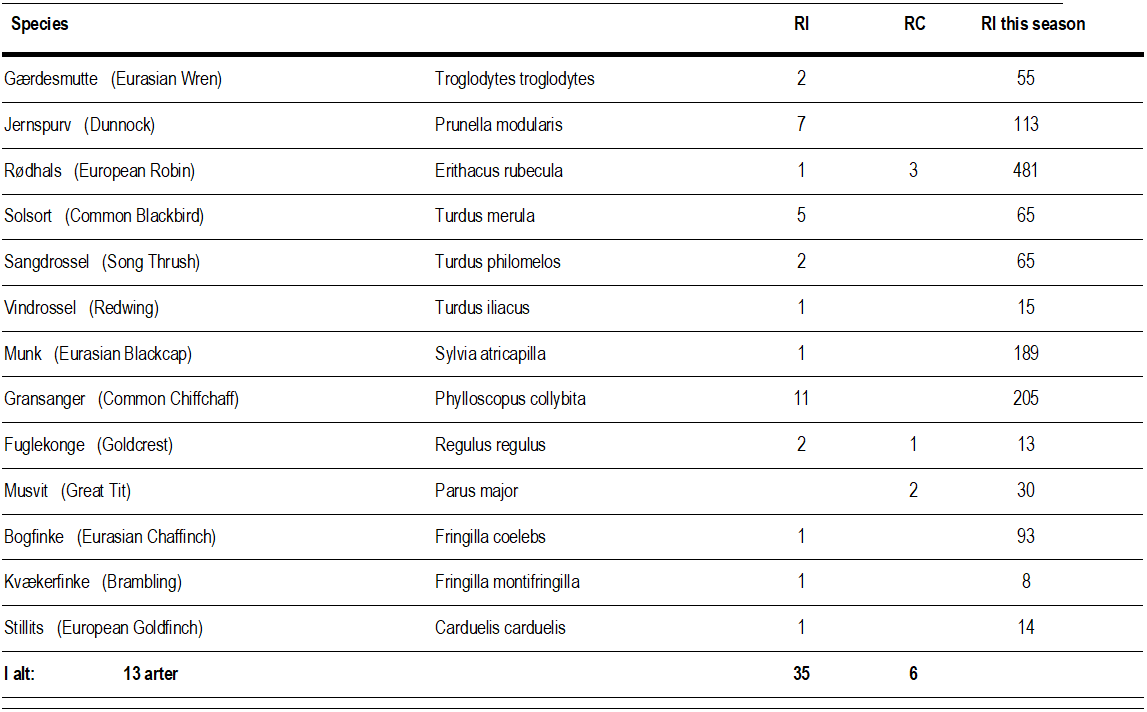
Today's numbers:
Observation: Today was an extremely uneventful day at obs, with no notable species to speak of. The only exceptions to this were the female Hen Harrier (Blå Kærhøg) that flew out from the Huk around the very start of obs, as well as the 6 resting Horned Larks (Bjerglærker).
As for the numbers, there is really not much to speak of either, with few (27) Red-throated Loons (Rødstrubet Lom), 367 Common Scoters (Sortand), 190 Starlings (Stær), and 55 Common Eiders (Ederfugl).
Other things: Today was also unfortunately Strummers last day at Blåvand Fuglestation before their visa would expire. They will be sorely missed, both at the nets ringing Nutcrackers (Nøddekrige), but also in the living room watching South Park and Paddington 2 on repeat. All the volunteers at the station look forward to hopefully seeing them again in the near future.
At the Station: Strummer Edwards, Mathilde Sif Eiby, Anton Ræbild Jensen, Johan Them Steffensen, Storm Hauris Borum, Helena
What a tease!
mandag 19. oktober 2026
Ringing: Another beautiful morning at the west coast, with gardens a bit too quiet besides the occasional thrush, but the Jackdaws (Allike) were still filling up the sky.
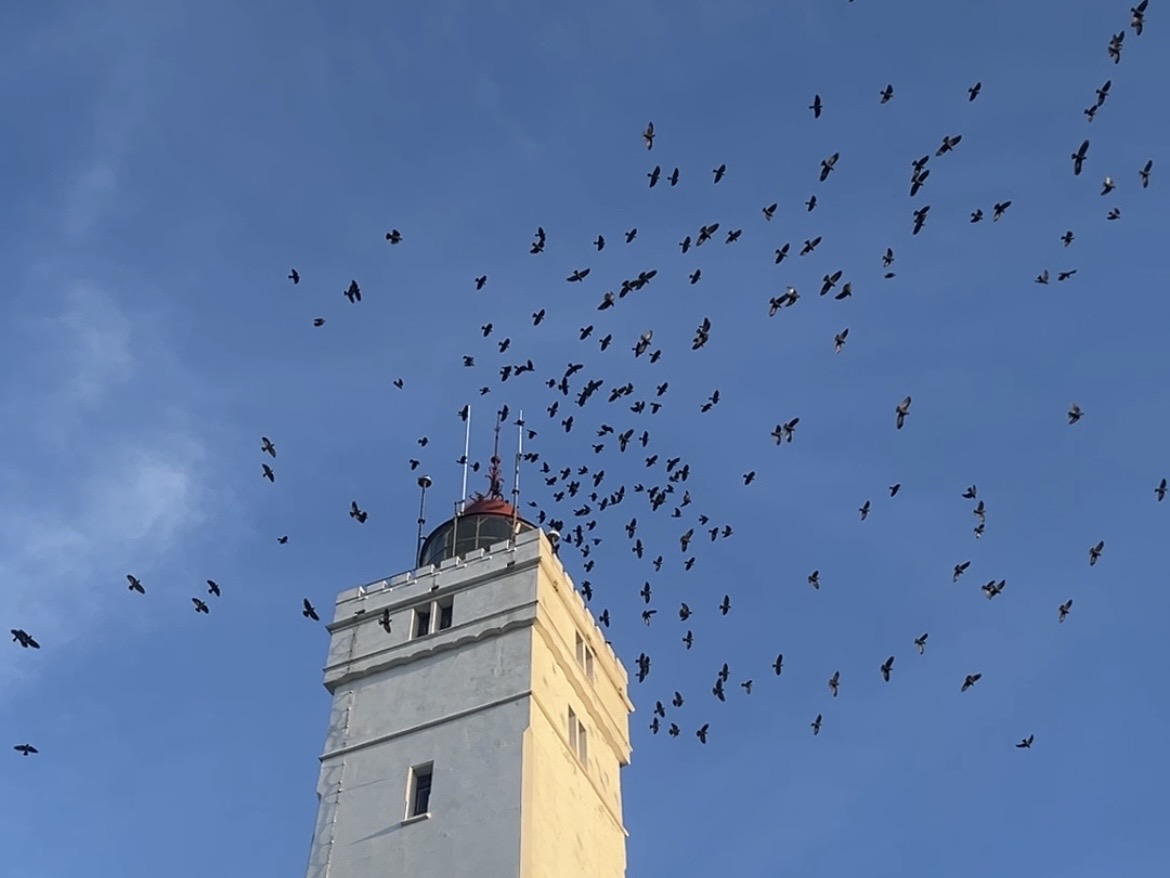 Jackdaws circling the lighthouse. Picture by Mathilde Sif Eiby.
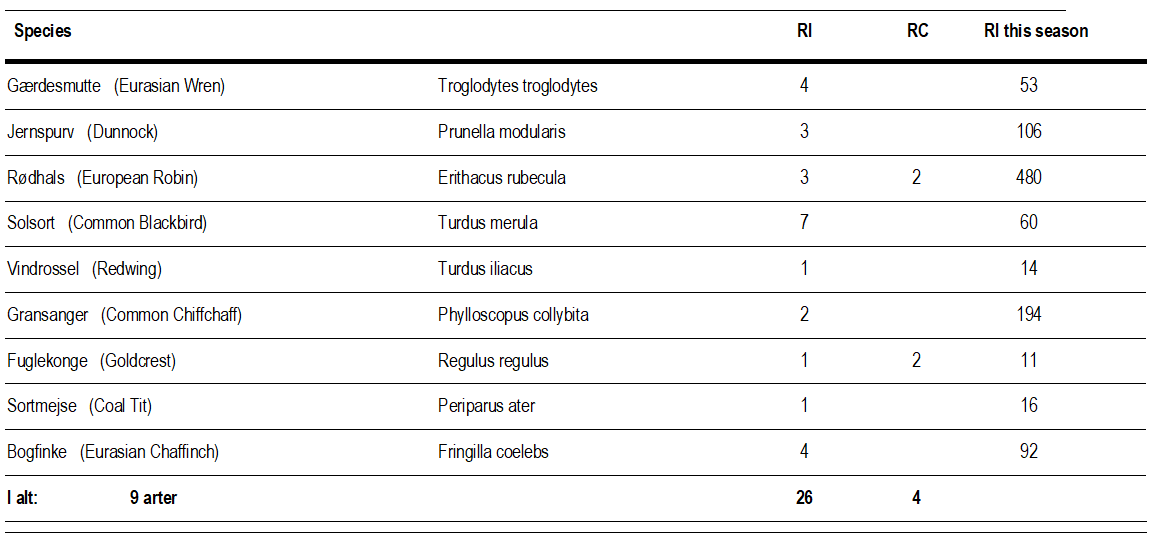
With the low volume day, we could introduce our new guest Helena, who's gonna be here for some weeks, to some ringing too. Our most numerous bird in the nets today was the Blackbird (Solsort), with 7 out of 30 individuals.
Just before closing, Storm and I were checking our non-standard nets, when Storm heard a Nutcracker (Nøddekrige) respond to our mixtape! I found it right after just chilling on a branch SO close to the nets and preening its feathers without a care for us. Despite our best efforts, it eventually flew off without visiting any nets though. It could have been our FOURTH ringed Nutcracker, and my first own ringed... crossing my fingers for the next few days!
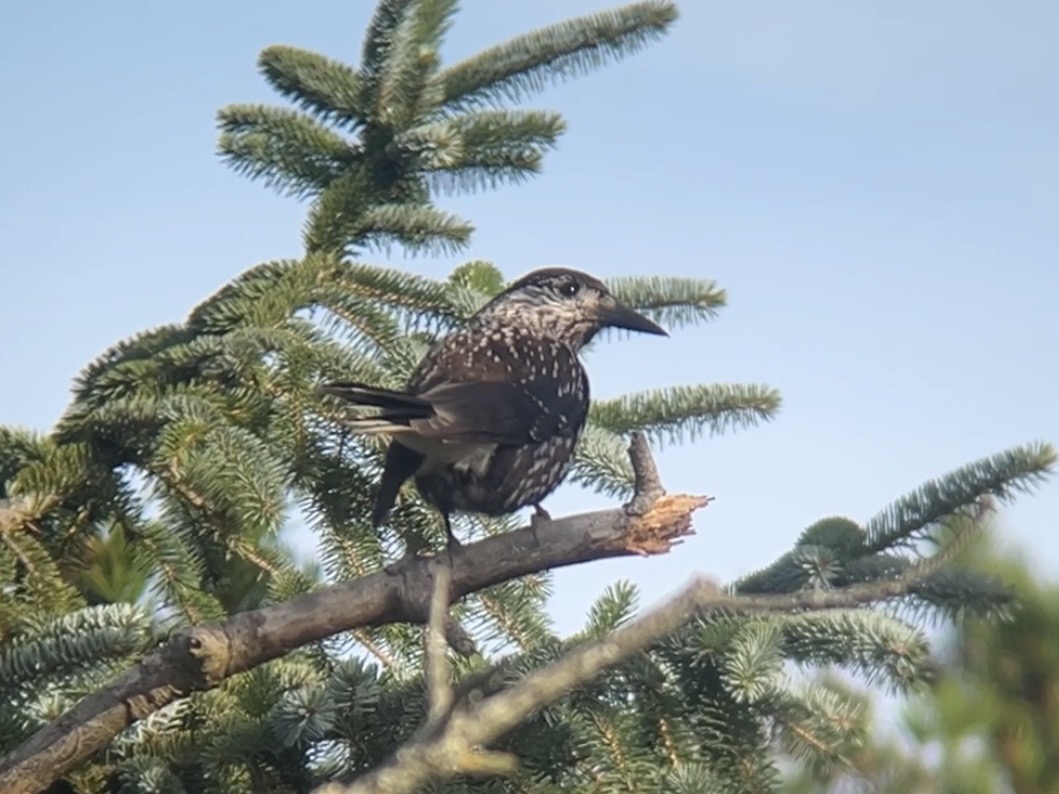 The Nutcracker teasing us today. Picture by Mathilde Sif Eiby.
Today's numbers:
Observation: Today was another beautiful but also cold day, with clear skies and a mild wind from the east. This is apparently also the perfect recipe for corvids, as today was another record-setting obs for a corvid species - this time Rooks (Råge)! With a mind-blowing 518 individuals in the sky, we at least matched the number from yesterday, and also probably beat it. Today also brought plenty of Jackdaws (Alliker), with over 4100 individuals flying by. The Starlings (Stær) were also, like yesterday, plenty - a nice 2060 birds visited us at obs.
What wasn’t like yesterday were the thrushes. With no Fieldfares (Sjagger), 1 Mistle Thrush (Misteldrossel), no noticeable migrating Blackbirds (Solsort), and only 240 Songthrushes/Redwings (Sangdrossel/Vindrossel), I wasn’t impressed. There were, however, a decent number of Chaffinches/Bramblings (Bogfinker/Kvækerfinker) at 880, which was a nice change.
We were also lucky enough to see 2 Hen Harriers (Blå Kærhøg) fly by, as well as 3 (at once) Nutcrackers (Nøddekriger). Overall, a pretty decent day, I’d say.
Other things: Later in the day a Pallas' Leaf Warbler (Fuglekongesanger) was spotted nearby, which we of course had to go see, and for Strummer's last evening, we went to the top of the lighthouse before dinner. From the top we even spotted a Polecat (Ilder) or Marten (Mår) running along one of our closed nets.
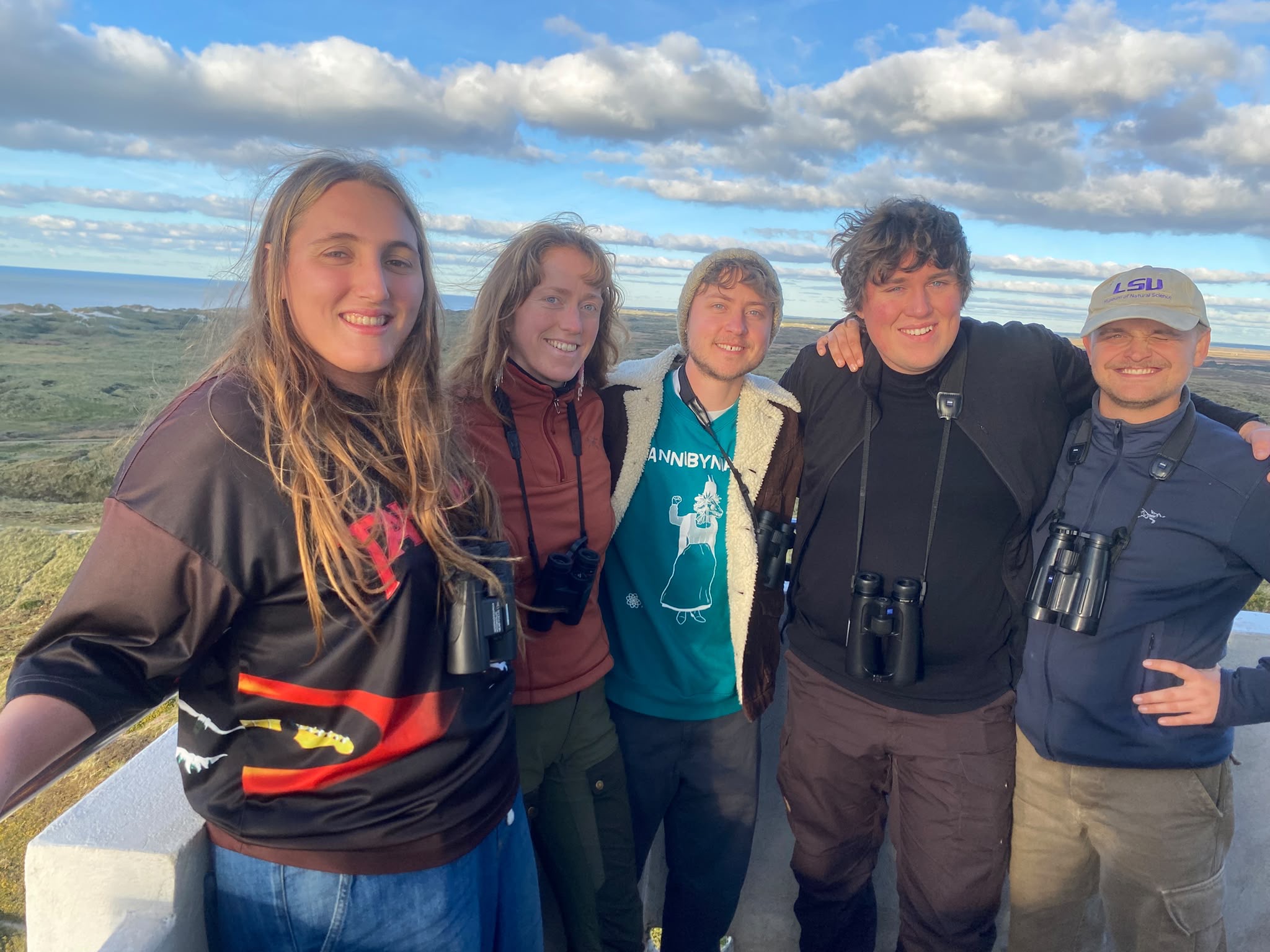 The October gang. Picture by german tourist.
At the station: Strummer Edwards, Mathilde Sif Eiby, Anton Ræbild Jensen, Johan Them Steffensen, Storm Hauris Borum, Helena
Corvid and thrush Mecca
søndag 18. oktober 2026
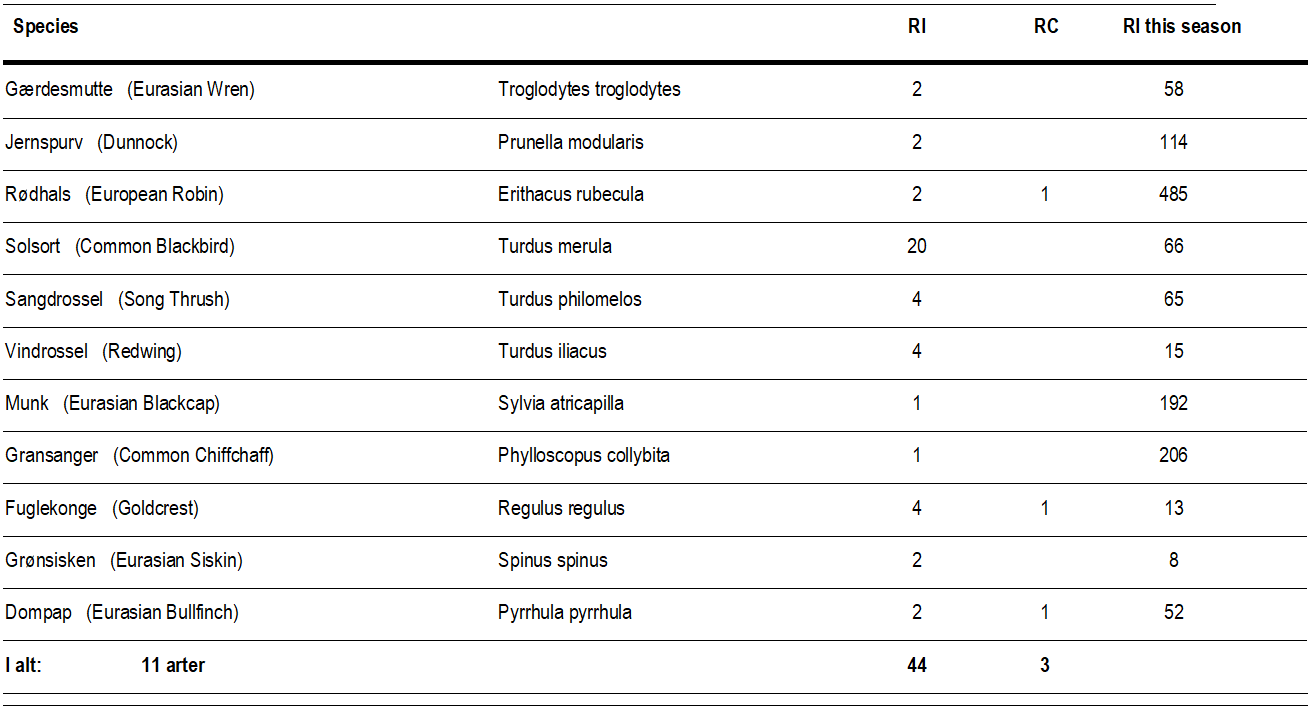
Ringing: Strummer, Johan and Storm were ringing today, but didn't mention anything exciting, besides 20 (TWENTY!) Blackbirds (Solsort) - I'm guessing one of our highest numbers of Blackbirds in a day ever?! That meant 28 thrushes in total out of 47 birds... I'd say that's a pretty good day.
Today's numbers:
Observation: My (Mathilde's) first day back at the station after a week at DOF UNG camp! I went for my potentially last obs of the season (depending on the weather), since I'll be taking Strummer's place as head ringer, when they sadly have to leave on Tuesday.
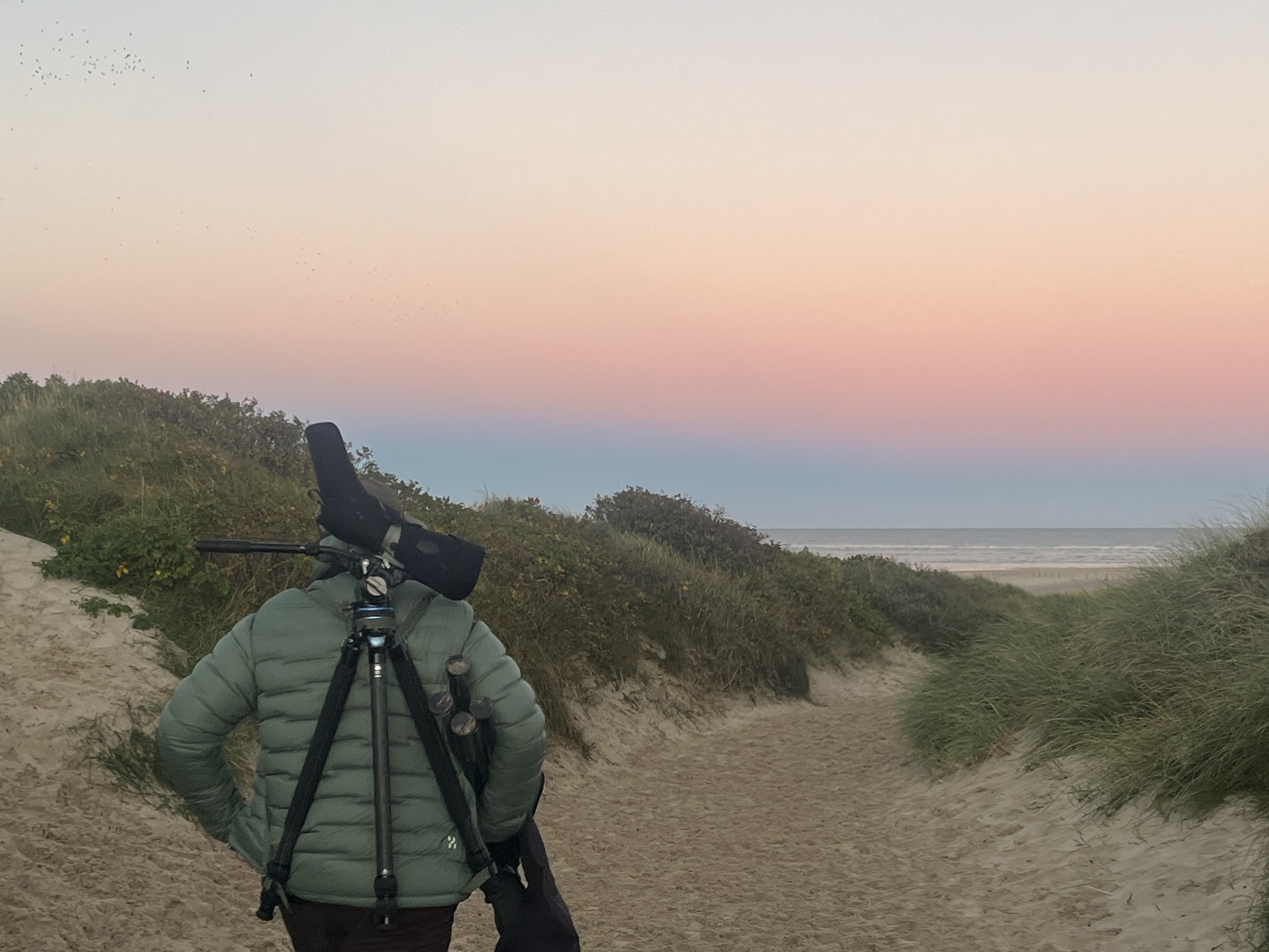 A nice walk to the observation post - corvids already fill the sky. Picture by Mathilde Sif Eiby.
Today we had striking numbers of corvids, and especially giant flocks of Jackdaws (Allike), totalling in 1970 definite individuals and 2710 mixed individuals of corvids, with an estimate of 80% of them being Jackdaws too. With this estimate it results in the highest number of Jackdaws ever counted during the standard at Blåvands Huk, with the previous record being 2881 individuals October 15th 1997. The rest of the corvids were mostly Rooks (Råge), approximately 500 individuals, which means we probably broke the record for Rooks as well, with the previous record being 345 individuals October 3rd 2024.
 So many Jackdaws flew right above our heads today. Picture by Mathilde Sif Eiby.
We also had a great amount of thrushes, with a mix of 2890 Redwings (Vindrossel) and Songthrushes (Sangdrossel) migrating south, being the second highest number ever counted here, only surpassed by an amazing observation of 4655 individuals October 12th 1977.
Other than that we had a good amount of Blackbirds (Solsort), our first Waxwing (Silkehale) of the season and a super nice Great Egret (Sølvhejre) flying right above our heads.
As the tide kept falling, in the last hour a White-tailed Eagle (Havørn) went to rest close by four adorable Harbor Seals (Spættet Sæl) out on the furthest visible shoal.
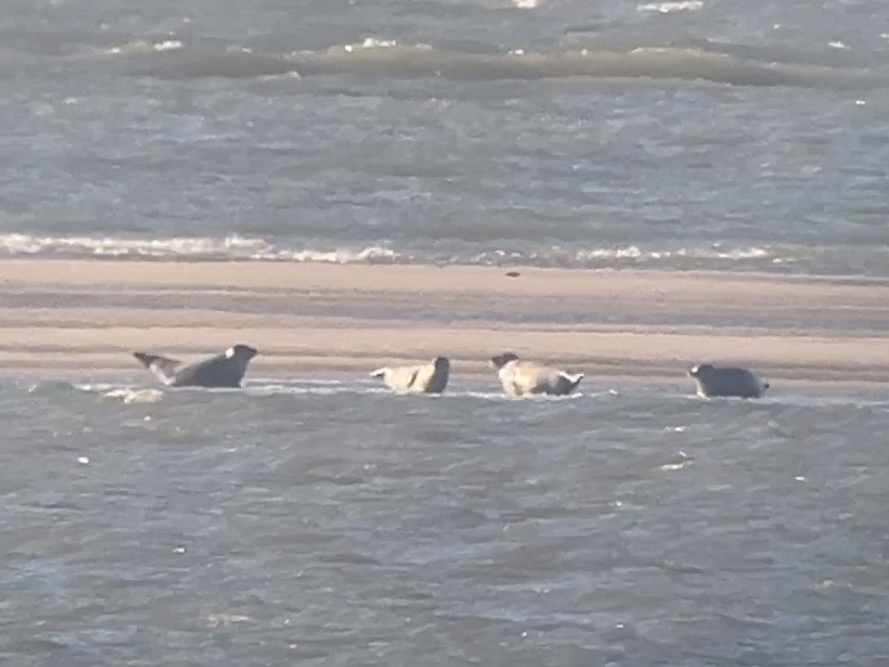 Four Harbor Seals enjoying the sun. Picture by Mathilde Sif Eiby.
At the station: Strummer Edwards, Mathilde Sif Eiby, Anton Ræbild Jensen, Johan Them Steffensen, Storm Hauris Borum