
Her på Blåvand's blog bringes korte nyheder i dagbogsformat om livet og hændelser på fuglestationen.
-
FORSIDE

- Blog
The calm after the storm
søndag 13. september 2026
Observations:
Ringing:
After the high that was yesterday, I should have predicted the low that was to come today, given our previous (lack of) luck this season. But alas, it was with an optimistic heart that I set out to open the nets this morning, hoping for a fun, slightly busy day split between the two gardens. Not even an hour (and not even 5 birds) went by before Strummer warned me about some ominous-looking clouds headed in our direction, and although DMI's radar didn't show any such precipitation, blindly trusting that piece of technology has come back to bite us before, so I decided to play it safe and only have the Station Garden open.
Although the clouds indeed did not bring much more than a very light drizzle (not enough to close the nets, but just enough to go rounds more frequently), the rest of standard time only brought 3 additional catches, as well as an almost-catch in the form of a Sparrowhawk that escaped just as I was running toward it. Thus, we ended with a total of 7 birds caught, all of them new, of which the bulk was young Robins (Erithacus rubecula) (3 individuals) and the next most common bird was the Common Chiffchaff (Phylloscopus collybita) (2 individuals).
The very last bird of the day, a Dunnock (Prunella modularis), was a bit unusual though. When taking it out of the bag, I threw a cursory glance at its tail, and seeing some pretty broad and rounded retrices (tail-feathers), I expected it to be an adult (2k+), but when looking at its wing to properly age it, it looked to be a young (1k) bird. After taking a proper look at its tail though, I realized what was going on.
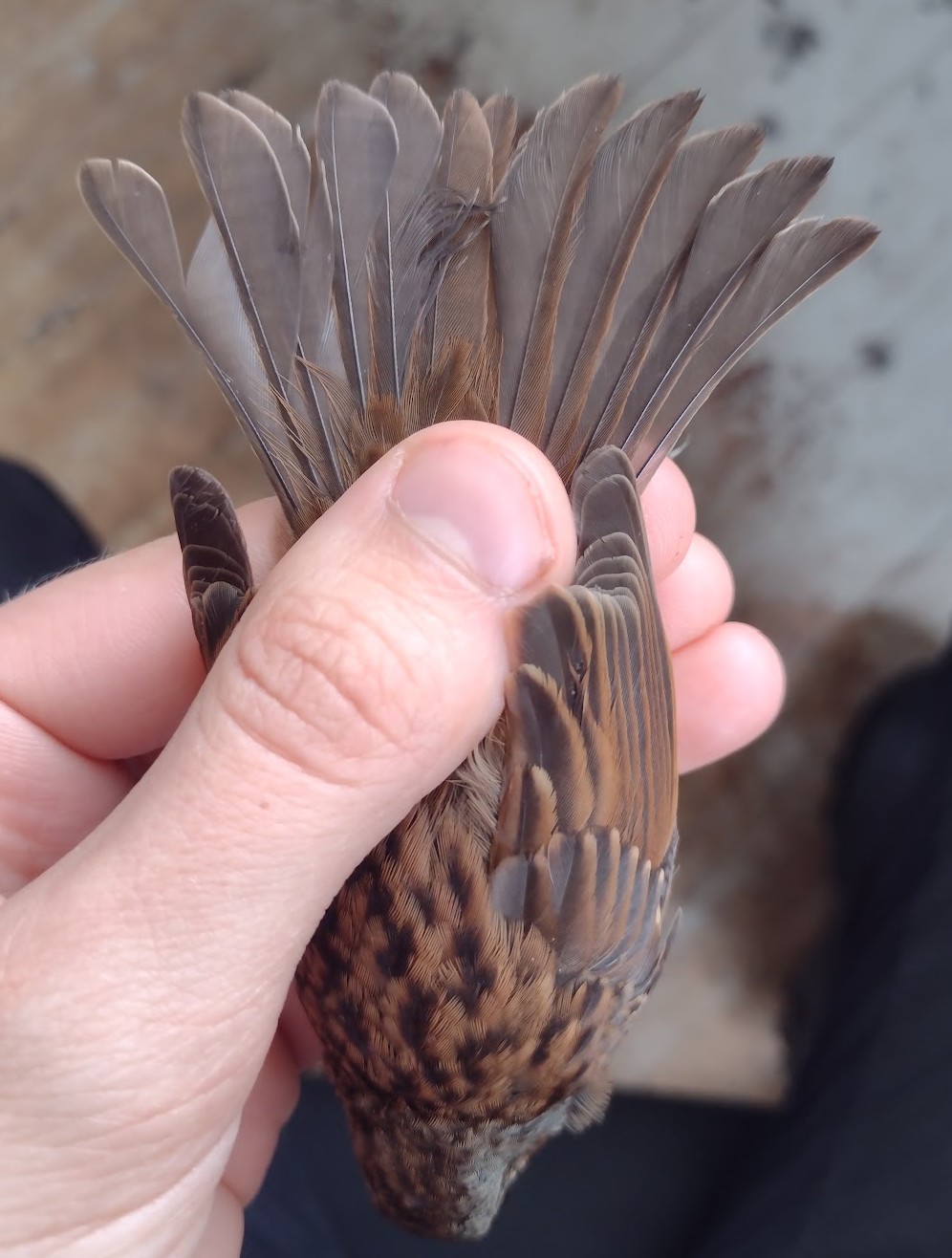
Tail of the Dunnock. Foto: Alba M. Holmberg
It had lost at replaced half of its tail!! On the picture above, it can be seen that half of the tail (the right half as seen from above) consists of feathers with quite narrow and sharp ends, as well as a more brownish ground colour, while the other (left) half has broad feathers with rounded ends, sporting a more uniform grey-ish colour. The sharp tail-feathers are textbook juvenile tail-feathers, while the rounded ones are typical of adult Dunnocks, so why does this bird have both types? The answer is quite simple: It must have lost half of its (juvenile-type) tail and then regrown the lost retrices as adult-type feathers!
This is one of the reasons that it is very dangerous to age a bird as being adult based only on the tail, as it could concievably have lost its whole tail at some point and then regrown it with adult-type feathers.
Another thing ringers look for in the tail-feathers when trying to age a bird is so-called growth bars, which are bands on the feathers of poorer quality than the rest of the feather originating from times where the bird did not get much to eat during the growth of the feather. For juvenile-type tails, these bands will usually allign pretty well with each other across the feathers of the whole tail, as juvenile birds typically grow out their whole tail at the same time. When adult birds moult their tails, however, they usually do that one pair of feathers at a time, so the tail is replaced in increments instead of all at once. Since not all of the tail-feathers grow out at once, any growth-bars will usually not allign across the whole tail. Thus, if the bars allign, its probably a young bird, and if not, its probably an adult. However, in the event of the tail getting lost when not in the context of moulting, all of the feathers can grow out simultaneously, even in adult birds, so there are exceptions to this rule.
Though it is difficult to see on the picture, it looks as if the adult-type half of the Dunnock's tail has growth-bars that line up pretty well with each other, indicating that the whole half of its tail was lost at once, maybe to something like a Sparrowhawk grabbing onto it.
Today's ringing totals:
Jernspurv (Dunnock): 1
Rødhals (European Robin): 3
Gransanger (Common Chiffchaff): 2
Løvsanger (Willow Warbler): 1
At the station: Strummer, Alba, Johan, Emil