
Her på Blåvand's blog bringes korte nyheder i dagbogsformat om livet og hændelser på fuglestationen.
-
FORSIDE

- Blog
Parting of the waters
fredag 4. september 2026
Observations:
Observations as follows: Still good numbers of Northern Gannets (Morus bassanus) , 235. Decent turnout of Turnstones (Arenaria interpres), 33, and the calm before the storm tomorrow B)
Ringing:
Parting of waters is, in this part of the world, most often associated with the story of Exodus, where the Hebrew god parted the waters of the Red Sea to allow for the Hebrews of Egypt to escape the country. The Egyptians themselves, however, also had experience with magically inducing similar phenomena, as is seen in the Westcar Papyrus, written more than 3600 years ago. The papyrus tells a story of the Old Egyptian king Sneferu (who lived about 1000 years ealier and built the first true pyramid) and how he on a boring day took to sailing on his palace lake, with twenty young women to man the oars. When one of the young women loses a very dear pendant and won't row until she gets it back, Sneferu consults his chief lector Djadjaemankh who, using magic, halves the water in the lake and puts it on top of the other half, thus allowing for the pendant to be retrieved.
Today, Blåvand Fuglestation experienced a silimar parting of waters. Forming out at sea, we saw huge blocks of rain-clouds approaching shore like tidal waves, but instead of hitting us, it's as if the western tip of land just outside the Lighthouse and the accompanying reef speared the clouds in half, forcing the two parts apart and leaving the Bird Station mostly dry, with only light drizzles hitting us for most of the morning. Because of this, we were surprisingly able to complete standard ringing, with us only having to close about 20 minutes prematurely when our luck finally ran out and the proper rain started to hit us.
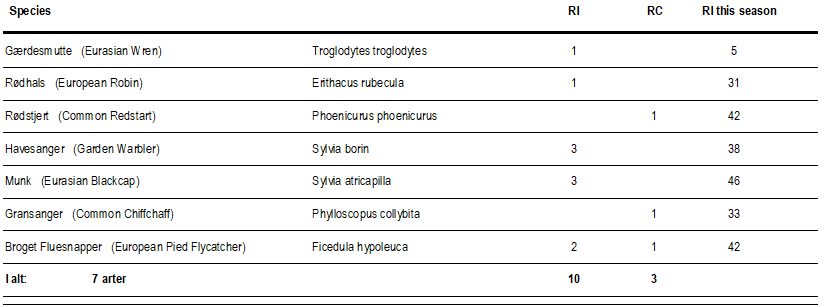
Despite our luck with being able to have the nets open, we were not so lucky when it came to actually catching birds in them. In total, we ended up with 13 birds caught, with 10 of them being new and 3 being recaptures. The title of most commonly caught species of the day is a tie between Eurasian Blackcap (Sylvia atricapilla), Garden Warbler (Sylvia borin) and Pied Flycatcher (Ficedula hypoleuca), with three individualt caught of each.
The highlight of the day for me was a very pretty young Pied Flycatcher female. Although we've been able to sex quite a few of the 1K (young) Pied Flycatchers we've been catching, almost all of them have been males, with very distinct white markings on the outermost tailfeathers and very dark black central tail and rump feathers. This bird, however, had an entirely light brown tail and rump, with dirty-white markings with diffuse edges on the outer retrices, marking it as a very clear-cut case of a female bird.
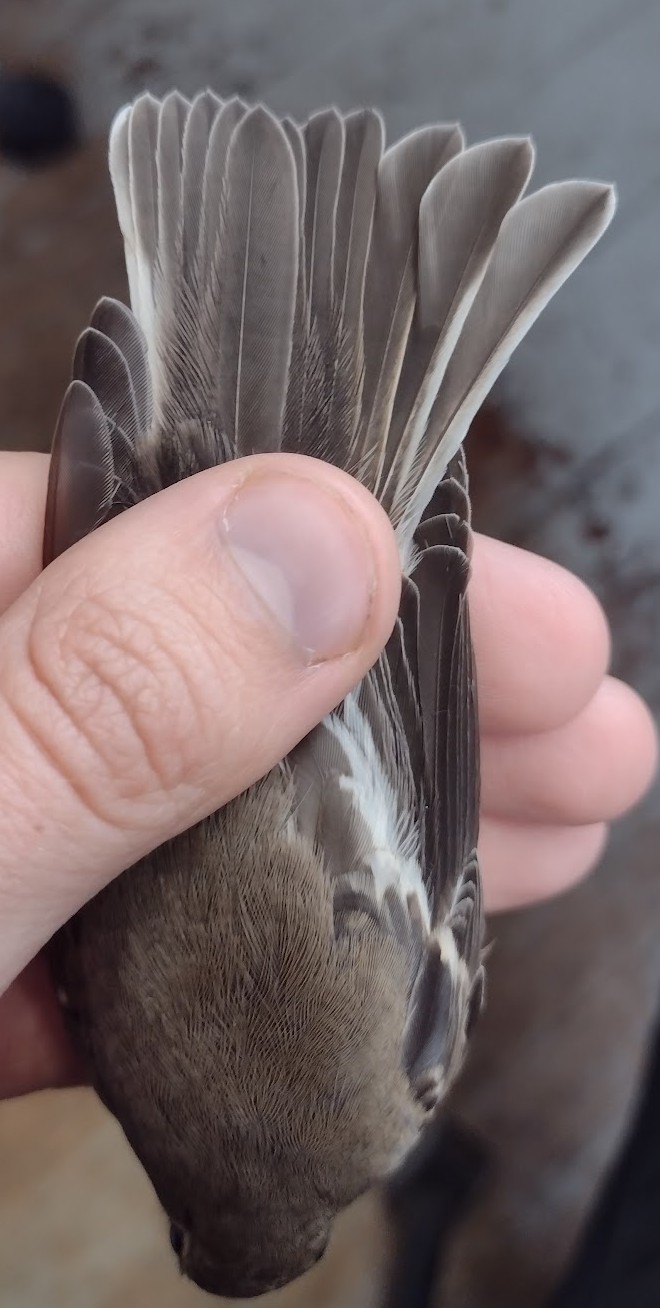
Young Eurasian Pied Flycatcher (Ficedula hypoleuca). The light brown tail, completely lacking in blackish-feathers, and with dirty white markings with diffuse edges on the outer tail-feathers marks this as a female Pied Flycatcher. Foto: Alba M. Holmberg
Today's captures:
At the station: Johan, Strummer, Alba, Henrik