
Her på Blåvand's blog bringes korte nyheder i dagbogsformat om livet og hændelser på fuglestationen.
-
FORSIDE

- Blog
Shifting baseline
onsdag 26. august 2026
Observations:
The morning wasn't exacly crazy today. I think we are kind of in a weird middle stage where most of the waders have gone, and we're still waiting on the big duck numbers. The day did provide a decent number of Eurasian Wigeons (Mareca penelope) in that category. The highest number was provided by Great Cormorants (Phalacrocorax carbo) funnily enough. 478 passed me on the tip, and in almost one entire flock. For a common species, the looks were still quite astonishing. Additionaly we had a White-tailed Eagle (Haliaeetus albicilla) come by, which greatly improved my mood. Always a cool bird :)
Ringing:
Many years ago, the number of small birds in Denmark was much larger than it is today. Back then, certain nature spots would host extremely diverse and numerous populations of birds that could fill out a sound-spectrograph with their varying songs and drown out any background-noise with their combined volume. As time has marched on, however, the environmental impacts of humans have helped reduce those numbers greatly, so now, many of these spots can offer only a small trickle of birdsong compared to the strong stream that used to flow. And while older generations might remember the old glory days and are able to recognize the relative drought of today, newer generations lack that perspective, and when you're used to looking for drops in a desert, that trickle might be percieved as a waterfall. Thus, what used to be few suddenly has become many.
This is an example of "shifting baseline syndrome", where the (often implicit) baseline against which something is measured slowly slides away from its previous value and toward a new one ("many" birds becomes a smaller and smaller number), sometimes so slowly that the observer(s) don't conciously notice until they check what the old baseline was many years ago. This shifting of baselines can happen through generational shifts, where the old baseline dies out with the older generation, but it can also happen on smaller timescales, where it is the fluidity of memory as well as forgetfullnes that lets the baseline slide.
During the last week, we the ringers at Blåvand have also experienced shifting baseline syndrome, though in an opposite manner to the example above. After two consecutive days with between 40 and 50 caught birds, our baseline has been violently rocked from its previous position of anything over 20 birds being considered a fantastic day, to being that anything less than 40 feels a bit drab without any unusual species to spice things up. Despite us being maybe a bit ungrateful for an objectively not-too-terrible day, we did enjoy being able to spend a bit more time with each bird again today, and the recapture of a Blue Tit (Cyanistes caeruleus) and the ringing of a new Spotted Flycatcher (Muscicapa striata), both of which being species we have only had a few of so far this season, did add a bit of flavour.
One of my personal highlights of today was actually in the form of a Garden Warbler (Sylvia borin). With the exception of maybe a few birds, all of the Garden Warblers we have caught so far this season have been young birds hatched this year (1k), which we have been able to tell by their very fresh tail- and wing-feathers. However, one of my Garden Warblers from today had tertial, primary and greater covert feathers that were quite worn, indicating that it was an adult (2k+) bird!
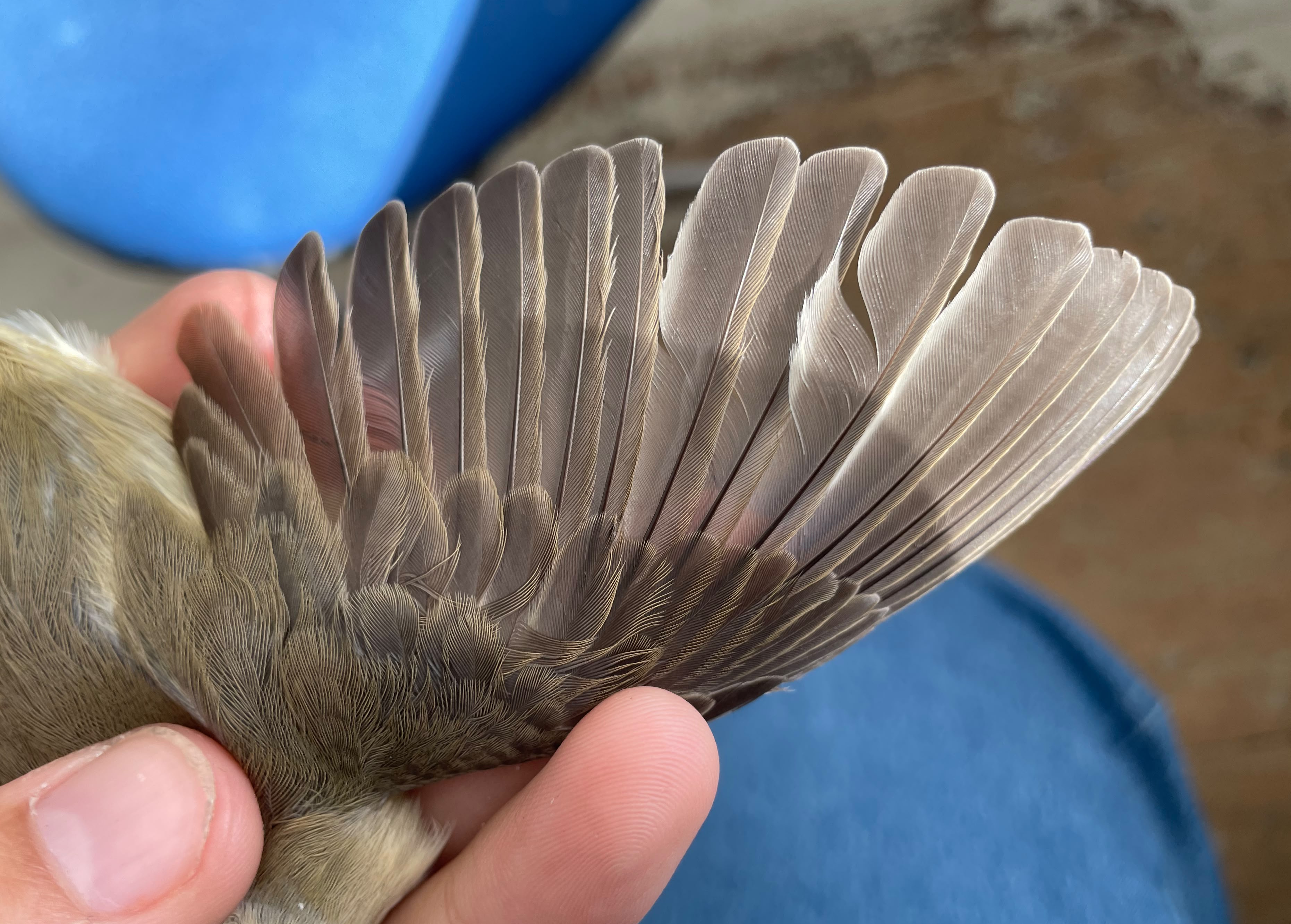
Young (1k) Garden Warbler. Notice the very fresh and un-worn feathers of wing, especially the tertials, primaries and greater coverts. Foto: Strummer Edwards.
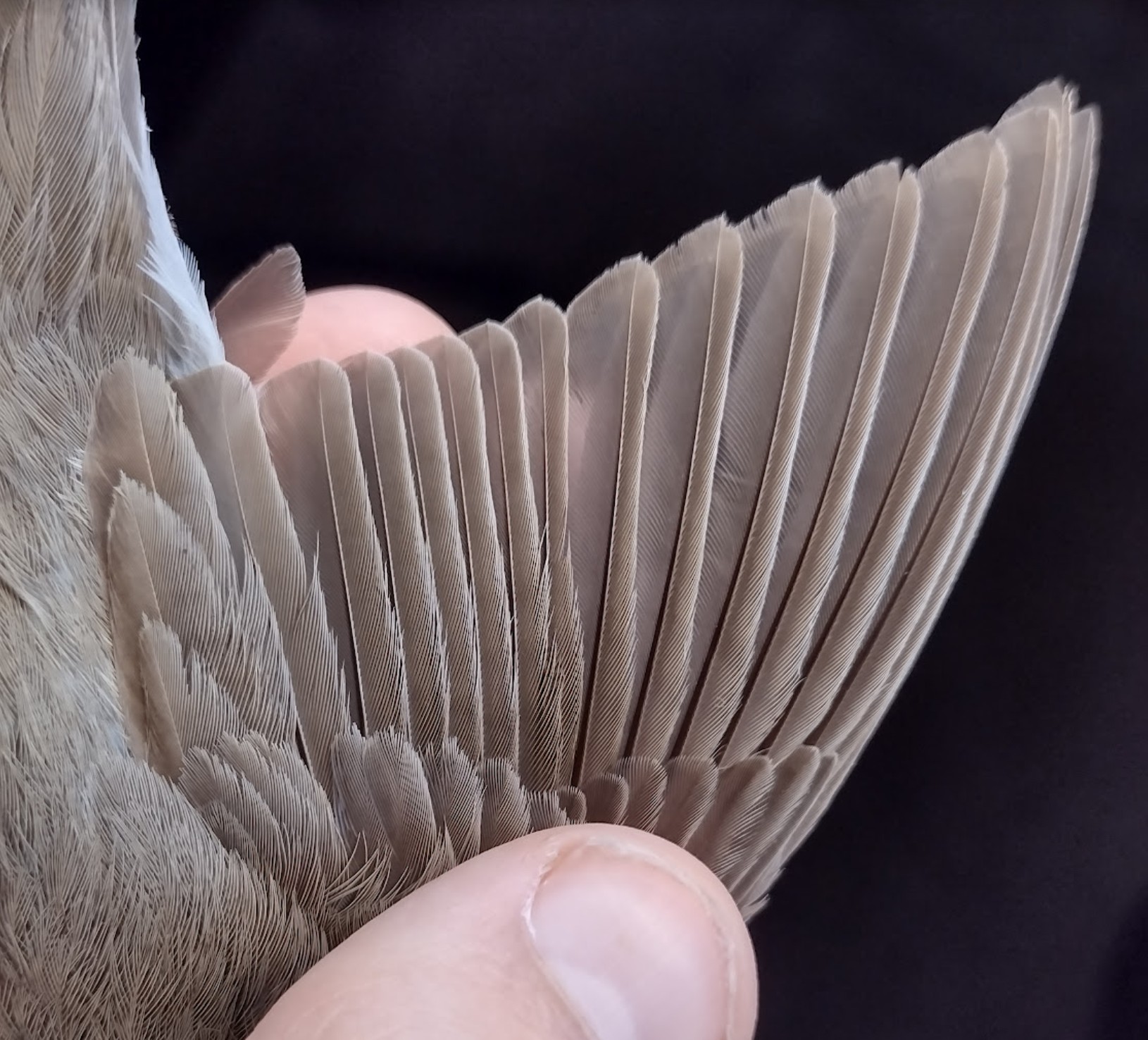
Old (2k+) Garden Warbler. Notice the very worn tips of the tertials, primaries and greater coverts. Foto: Alba M. Holmberg.
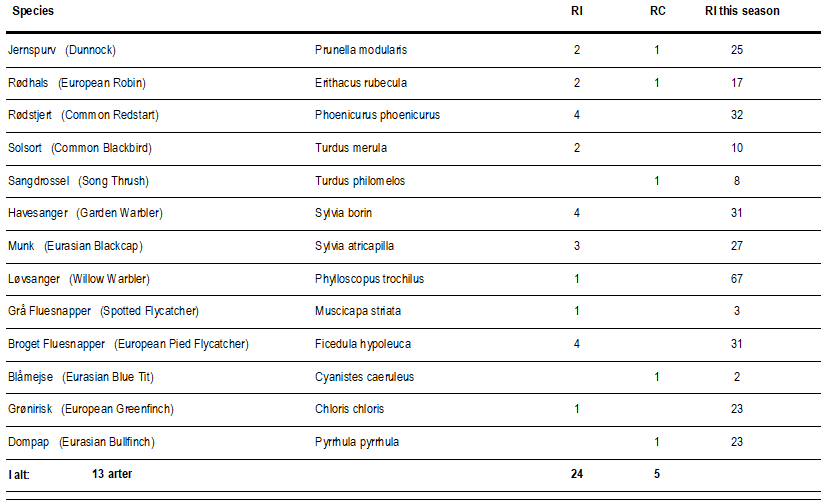
Today's captures:
At the station: Strummer, Alba, Johan