
Her på Blåvand's blog bringes korte nyheder i dagbogsformat om livet og hændelser på fuglestationen.
-
FORSIDE

- Blog
Nightcatching gives results!!!
fredag 7. august 2026
Observations:
Ringing:
The ringing today started just after the middle of the night, when Ida and I went out to try nightcatching again. After a bit of practice with the spotter, flashlight and ketcher-net, our efforts finally gave a return in the form of a beautiful little Dunlin (Calidris alpina)! We took it back to the lab to get a look at it in a better light, and after I helped Ida get a ring on it (this being her first time putting on a steel ring), we began to study its plumage in order to age it. This was the first time I had ever handled, much less had to age, a shorebird, so it was a bit challenging, but in the end we managed to figure out it was a 1k bird (that is, hatched previously in this year)!
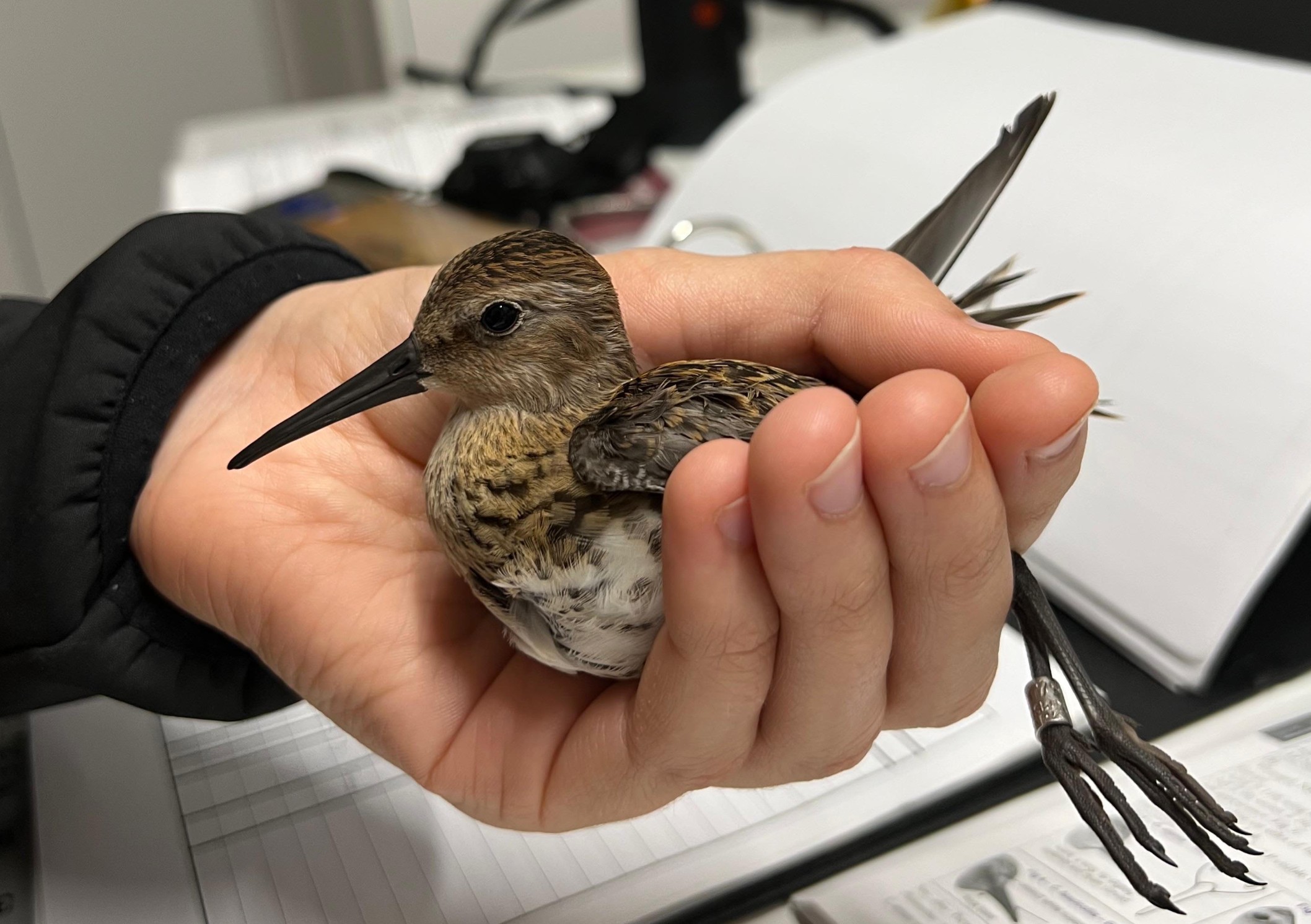
Dunlin being held in the lab. Foto: Ida Bek
After the rest of the measurements were done, we took it back to the beach and let it sit in the dark for some minutes, until its eyes could recallibrate to the darkness, before we released it. Still having a couple hours before dawn, we set out to try to catch more, and after barely half an hour, we again had a bird in the net: A cute juvenile Common Ringed Plover (Charadrius hiaticula)! Again, we waded over the dunes at the lighthouse to get back to the lab, and while handling the bird, we noticed that each foot was a toe short of what most birds have; turns out Common Ringed Plovers have lost their first toe, the so-called hallux, which is the toe that points backward in most (anisodactyl) birds!
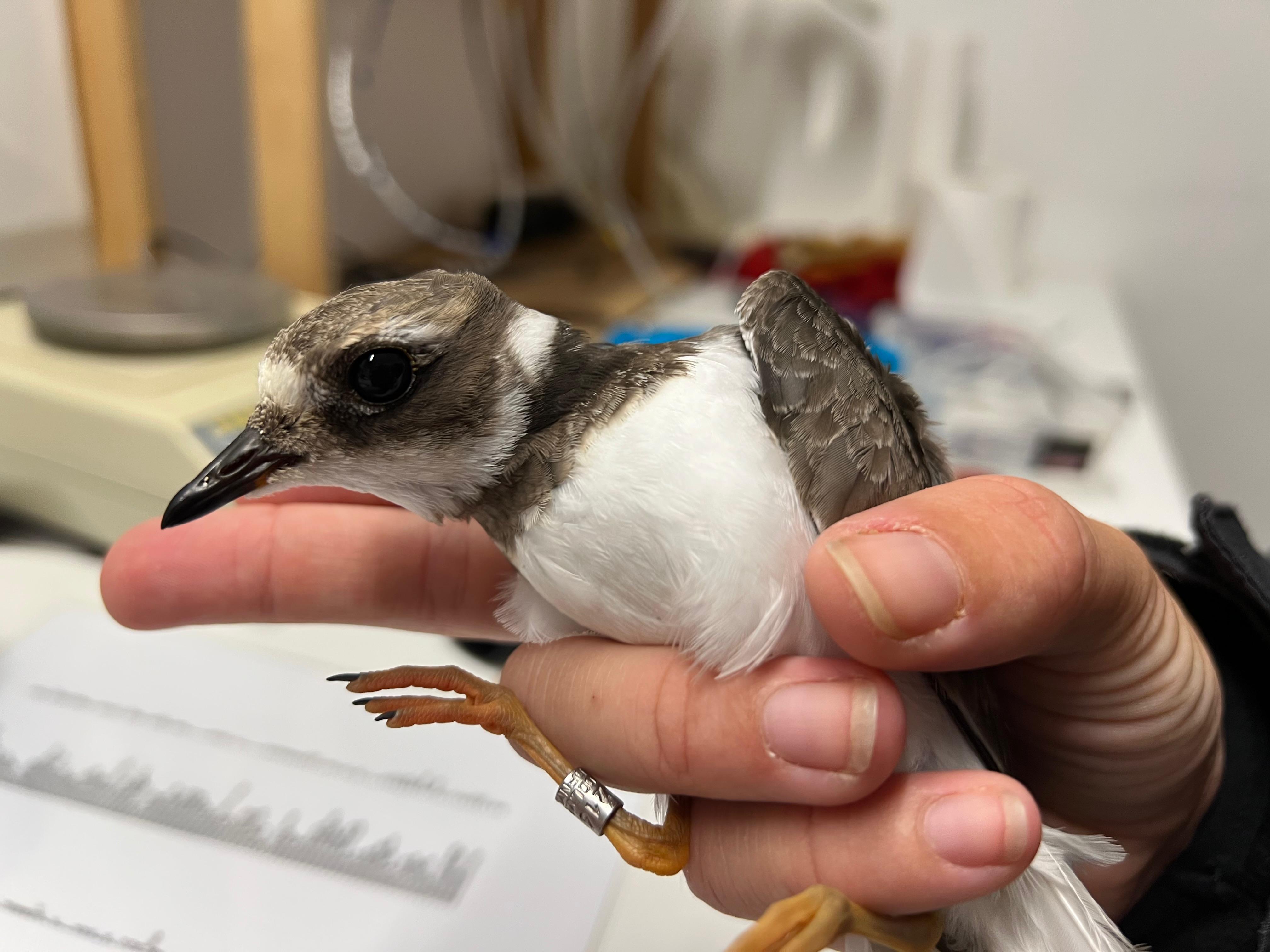
Common Ringed Plover in the lab, showing off its ring. Note that each foot only has 3 toes. Foto: Ida Bek
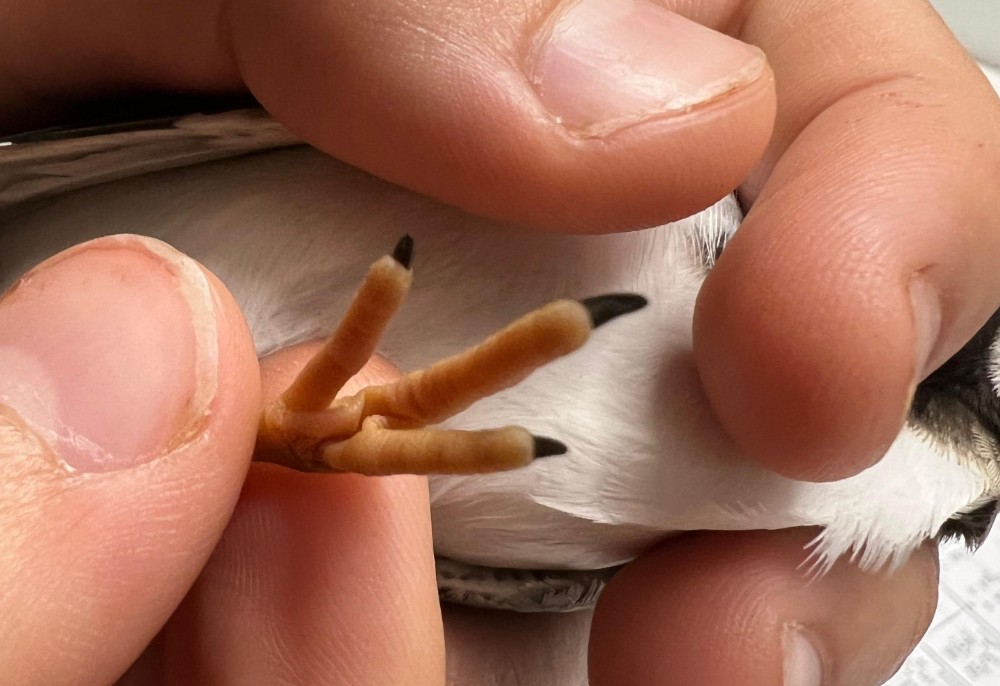
Close-up ventral view of the foot of the Common Ringed Plover. Foto: Ida Bek
After releasing the plover, we did not have enough time to catch anything more before the sky started to turn light again, removing the element of surprise from any approach toward the birds. The approaching dawn also brought with it the start of standard ringing which, because of strong north-western winds, had to be conducted with only the most sheltered of nets. The combination of bad conditions and little nets unsurprisingly made for a horrible day of standard-time: Johan and I ended up wandering up to and down from the lighthouse 10 times just to catch only one (1) bird. That one bird was a very cute juvenile female European Stonechat (Saxicola rubicola) though, so at least we got to ring a bird we haven't caught for a few days.
After standard was over, we all drove down to Ho klitplantage to first look at some waders, and afterwards go into the forest-area to look (and listen) for Willow Tit (Poecile montanus) and Wood Warbler (Phylloscopus scibilatrix). We succeeded at finding both species (with Willow Tit being a new lifer for me), and on the way back, we also managed to find some pretty cool invertebrates, such as a Wasp spider (Argiope bruennichi) and a great green bush-cricket (Tettigonia viridissima).
Later in the day, we got three new arrivals: Laima from Lithuania, and Jule and Thiemo from Germany, who will stay the weekend in order to scout Blåvands Huk for places to put an antenna, which they will use to help track birds with radio-transmitters for a project that seeks to study the effects of off-shore wind farms on the migration-behaviour of passerine birds. Hopefully they will be able to build this antenna and start to put the small, non-invasive transmitters on birds by next autumn. We're all very excited to see what they learn from this project!
At the station: Alba, Johan, Ida, David, Lois, Nico, Miguel, Henrik, Laima, Jule, Thiemo