
Her på Blåvand's blog bringes korte nyheder i dagbogsformat om livet og hændelser på fuglestationen.
-
FORSIDE

- Blog
Sexing breeding birds
mandag 8. juni 2026
This morning the weather was a little bit windy from the south, and throughout the standard time a few drops of rain kept taunting me and making me wonder if it was going to rain a lot or not! In the end, the rain never picked up and I could have all the nets open for the whole time with no problem.
The proportion of newly ringed birds and recaptured local birds is a 50/50 today, with 5 recaptures and 5 new ringed birds.
Only one ‘baby’ was recaptured today, which makes me wonder if the weather was slightly too bad for the little ones learning to fly and explore, and that maybe they preferred to stay put and safe in a bush in the garden. It was a very sweet baby Dunnock (Jernspurv) that was ringed a couple of days ago.
A little highlight of today was a beautiful male Lesser Redpoll (Lille Gråsisken), which was quite vocal in the hand; so cute!
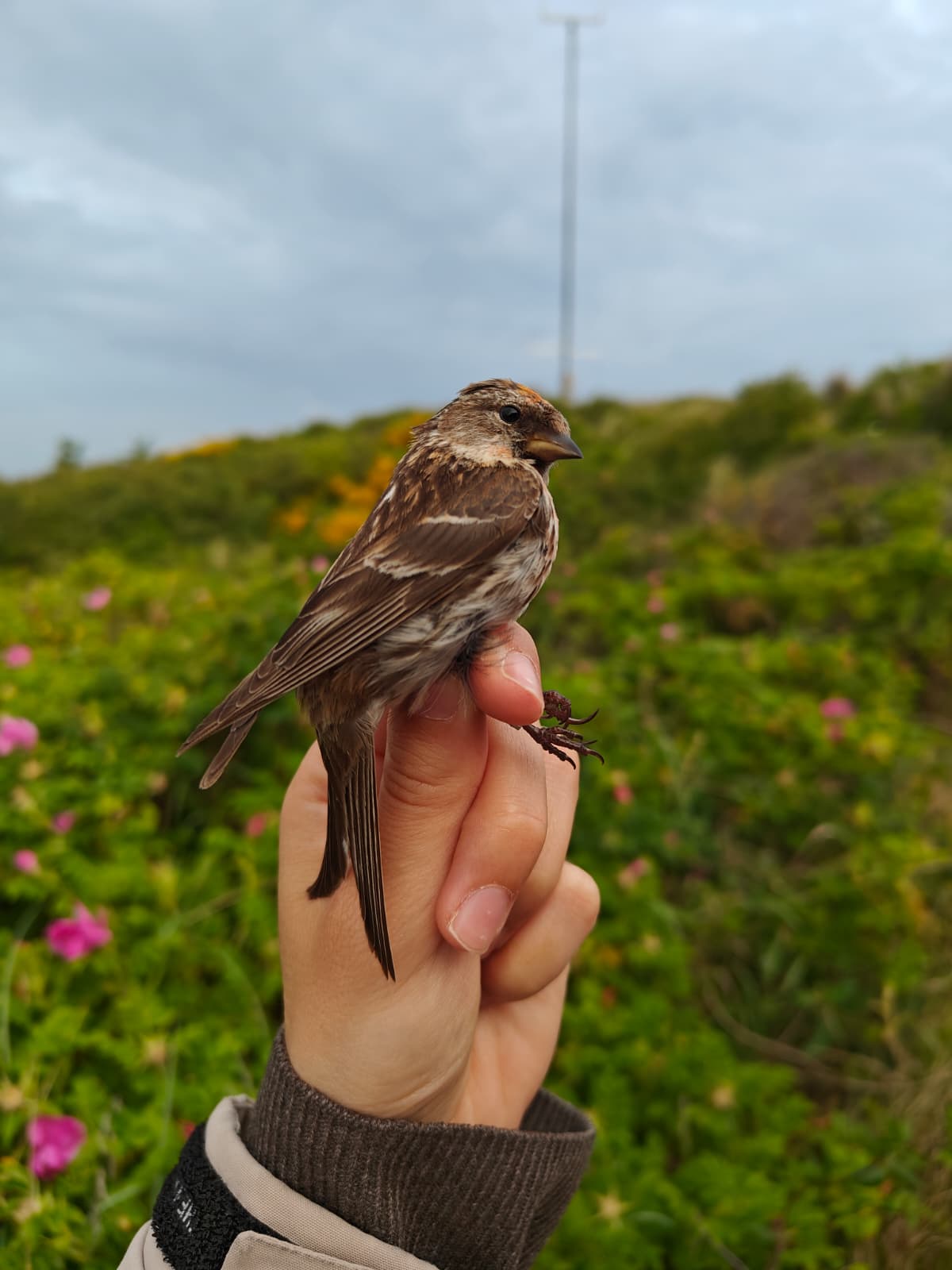 Beautiful male Lesser Redpoll (Lille Gråsisken)
At this time of year, the birds exhibit breeding signs such as brood patches, a defeathering of the chest and belly area to better transfer heat to the eggs while incubating, as well as cloacal protrusion on males which is a protrusion of the cloaca, to better deliver sperm to the females.
These two characteristics are making it possible to sex some species that would usually not be possible to distinguish based on plumage, like the Chiffchaffs (Gransanger) for example.
The presence of a clear cloacal protrusion is indicating of a male bird, and most of the time the presence of a brood patch would indicate that the bird is a female. As a note though, some species such as Whitethroats share the incubation of eggs between males and females, so both sexes can have brood patches, making it not useful for sexing.
It is useful to know the incubation strategies of the common species when ringing breeding birds, and I am so glad that I had the opportunity to learn about breeding bird ringing at the CES site in Vestamager, Copenhagen last year. There is extra care to be taken with breeding birds who are putting all their energy into their broods, incubation, feeding of young, nest building, etc, as well as juvenile birds who are still developing, need to stay in the area they are caught for their parents to not loose sight of them, to leave them in an environment they have already explored a little bit, etc.
I find this period to be a very different type of ringing compared to migration time ringing for example, and I really like it. The birds exhibit some special behaviors and it is so endearing to catch youngs and breeding parents! I have a very nice time caring for parents and babies, and adapting my ringing routines to have as little of an impact on their day as possible.
Ringing totals for today:
Jernspurv (Dunnock): 0/1
Gærdesanger (Lesser Whitethroat): 1
Gransanger (Chiffchaff): 3/1
Løvsanger (Willow Warbler): 0/2
Tornirisk (Linnet): 1
Lille Gråsisken (Lesser Redpoll): 0/1
Total: 5/5
People at the station: Alix Bortolussi